SAP
AMS
Atlassian
Produkte
Industrien & Expertise
BEST-SHORING
Wissen
SALESFORCE


In today's competitive landscape, enterprises operate on two primary engines: a system of record that manages core business processes, and a system of work that drives innovation and development. For many of the world's leading companies, these engines are SAP and Atlassian, respectively. SAP serves as the backbone for finance, logistics, and operations, while Atlassian's suite—Jira, Confluence, and Bitbucket—powers agile project management, collaboration, and software development. The challenge, however, is that these two powerful engines often run in isolation, creating a disconnect that hinders agility, transparency, and efficiency. This article presents a blueprint for bridging that gap and building a truly Connected Enterprise.
When SAP and Atlassian operate as separate islands, the friction between business operations and IT development creates significant pain points. Business stakeholders lack visibility into the progress of critical IT projects, while development teams struggle to understand the business context and priority of their work. This disconnect manifests in several ways:
Integrating SAP and Atlassian is not just about connecting two software systems; it's about aligning business strategy with technical execution. A Connected Enterprise creates a seamless flow of information from business requirements to development, testing, and deployment. Here are the four key pillars of this integration.
Large-scale SAP projects, particularly S/4HANA migrations, are complex undertakings that benefit immensely from agile methodologies. By using Jira as the central project management tool, organizations can break down the project into manageable epics, user stories, and tasks.
This approach allows for iterative development, continuous feedback, and better risk management. When integrated, a business requirement logged in SAP Solution Manager can automatically create an epic in Jira. As the development team makes progress, the status is synchronized back to SAP, providing real-time visibility to all stakeholders. For portfolio-level planning, Jira Align can be used to connect the strategic business objectives with the day-to-day development work being done in Jira.
This is one of the most powerful use cases for SAP and Atlassian integration. Traditionally, moving ABAP code from development to production is a heavily governed process managed by SAP ChaRM (Change Request Management). By integrating ChaRM with Jira, you can automate this entire workflow.
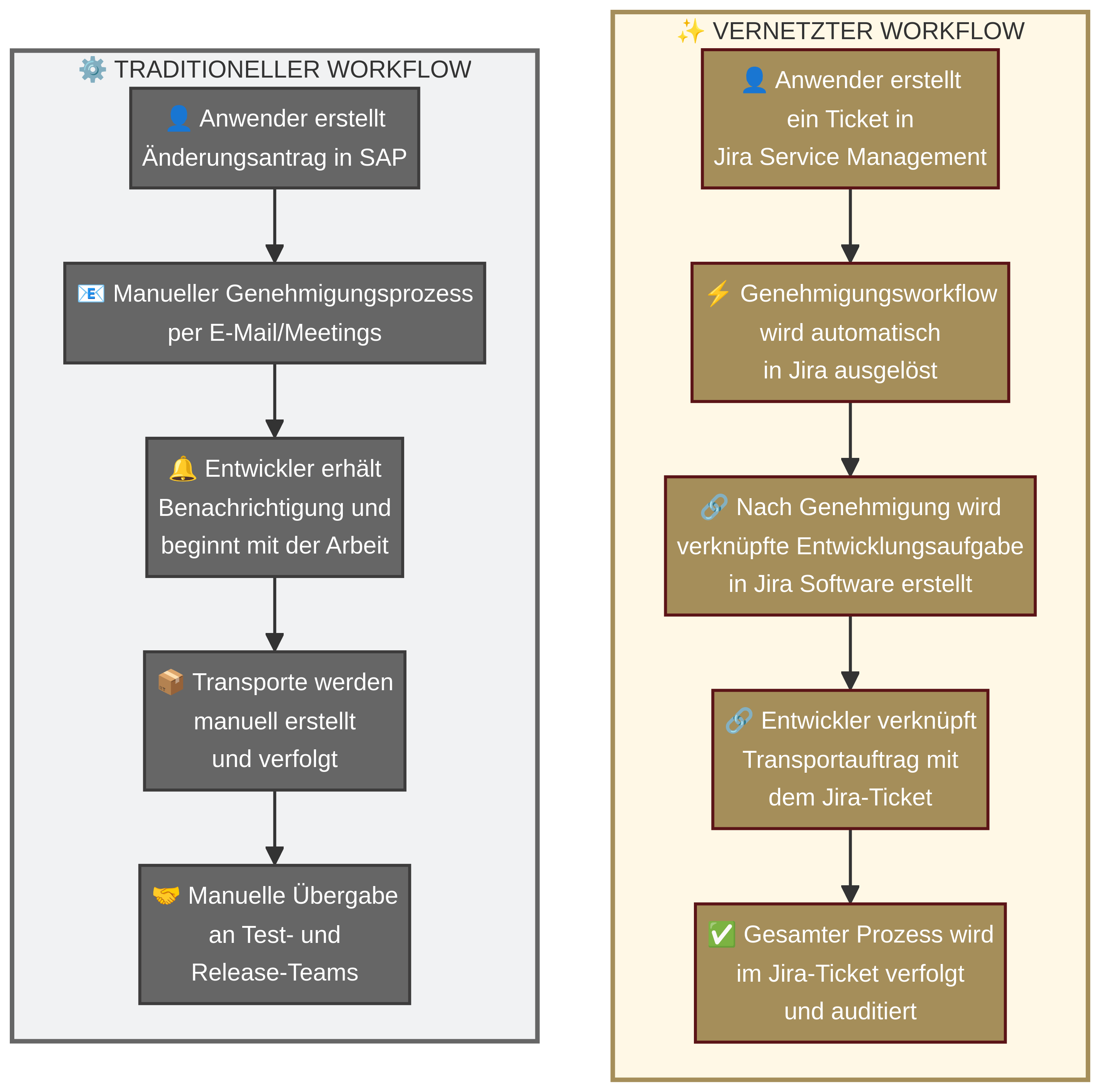
This integration, often facilitated by marketplace apps like the SAP Integration Kit for Jira or custom solutions using the Jira Receiver Adapter in SAP Integration Suite, provides a complete, auditable trail for every change, dramatically improving compliance and reducing manual effort.
Effective documentation is the bedrock of a maintainable SAP system. However, it is often scattered across various platforms. Confluence can serve as the central, living knowledge base for your entire SAP landscape.
By using Confluence, teams can:
A fully Connected Enterprise extends beyond project management and documentation to the entire DevOps lifecycle. By integrating the full Atlassian stack with SAP, you can achieve a modern, automated development process:
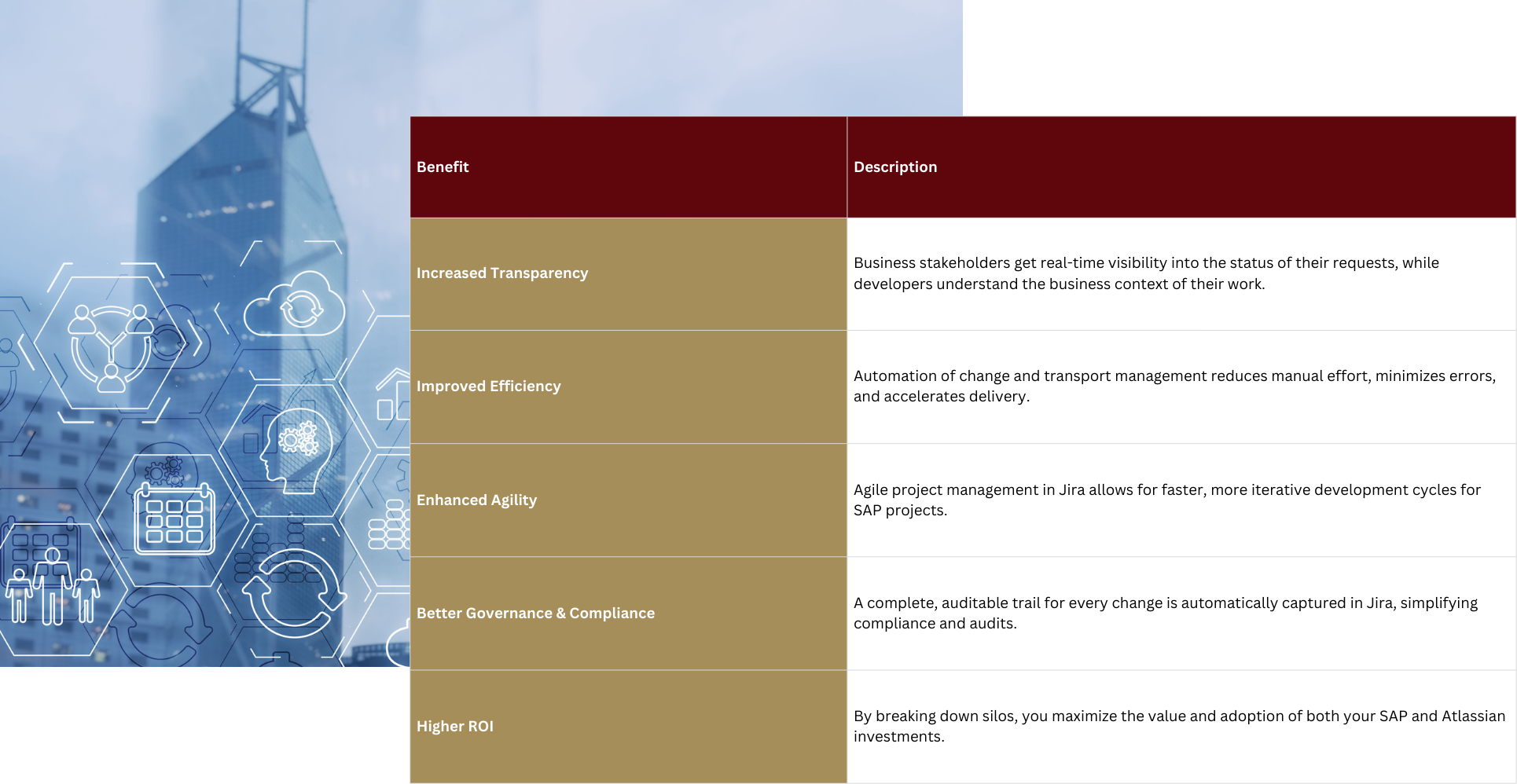
Integrating SAP and Atlassian delivers tangible benefits across the organization:
The Connected Enterprise is more than just a technical integration; it is a strategic approach to aligning your systems of record and systems of work. By creating a seamless bridge between SAP and Atlassian, you can break down the silos that hinder growth, empower your teams with the information they need, and build a more agile, transparent, and efficient organization. As a partner with deep expertise in both the SAP and Atlassian ecosystems, Lupus Consulting is uniquely positioned to help you design and implement the blueprint for your Connected Enterprise.

Smarter arbeiten mit KI-gestützter Zusammenarbeit: Erleben Sie, wie Atlassian Intellige