Lupus Consulting

SAP Extended Warehouse Management (EWM) is a comprehensive software solution for managing complex, high-volume warehouse operations and integrating them into broader supply chain logistics. EWM provides granular control over physical movements, inventory, and warehouse processes to improve accuracy and efficiency across a distribution center. For IT leaders and CTOs, SAP EWM can reduce operational costs and enable more efficient supply chain execution.

Quick Answer

SAP EWM (SAP Extended Warehouse Management) is an advanced warehouse management system that controls inbound processing (goods receipt and putaway), outbound processing (picking, packing, staging, loading), internal movements (replenishment and inventory), and yard management (trucks, trailers, dock doors). It offers features beyond legacy SAP WM (SAP Warehouse Management), such as labor management, value-added services (VAS), and material flow control (MFS). EWM can be deployed embedded in SAP S/4HANA or as a decentralized system.
What SAP EWM means (acronyms and definitions)

  • SAP EWM: SAP Extended Warehouse Management — an advanced warehouse management application from SAP.
  • SAP WM: SAP Warehouse Management — the legacy warehouse management functionality historically embedded in SAP ECC.
  • S/4HANA: SAP Business Suite 4 SAP HANA — SAP’s next-generation ERP suite using the HANA in-memory database.
  • HANA: High-performance ANalytic Appliance — SAP’s in-memory database technology used for real-time analytics.
  • MFS: Material Flow Control (also referred to as Material Flow System) — automation integration for material handling equipment.
  • VAS: Value-Added Services — additional warehouse services such as kitting, labelling, or customization.
  • 3PL: Third-Party Logistics — logistics service providers that handle warehousing and distribution for other companies.
  • SAP Fiori: SAP’s design language and UI framework that provides a modern user experience.

Core modules and capabilities

SAP EWM is designed for high-complexity warehouse environments and provides fine-grained control of physical movements:

  • Inbound Processing
    • Goods receipt handling
    • Complex putaway strategies
    • Quality inspection routing
  • Outbound Processing
    • Wave picking and other picking strategies
    • Packing, staging, and loading for goods issue
  • Internal Movements
    • Replenishment
    • Physical inventory counting
    • Rearrangement and internal transfers
  • Yard Management
    • Visibility and control outside the warehouse walls: trucks, trailers, and dock doors

EWM also supports advanced features such as labor management and value-added services (VAS), and it can integrate with automated material handling equipment via material flow control (MFS).

SAP EWM vs SAP WM — key differences

  • SAP WM (Warehouse Management) is the legacy module embedded in SAP ECC; SAP EWM is a more advanced successor.
  • EWM offers significantly more granular control over warehouse operations.
  • EWM includes features that are limited or absent in WM, such as:
    • Labor management
    • Yard management
    • Value-added services (VAS)
    • Material flow control (MFS)
  • Support context: SAP WM support is scheduled to end in 2027, which makes migration to EWM a strategic consideration for many organizations.

Key features in S/4HANA

  • HANA in-memory database enables real-time analytics and reporting for warehouse operations.
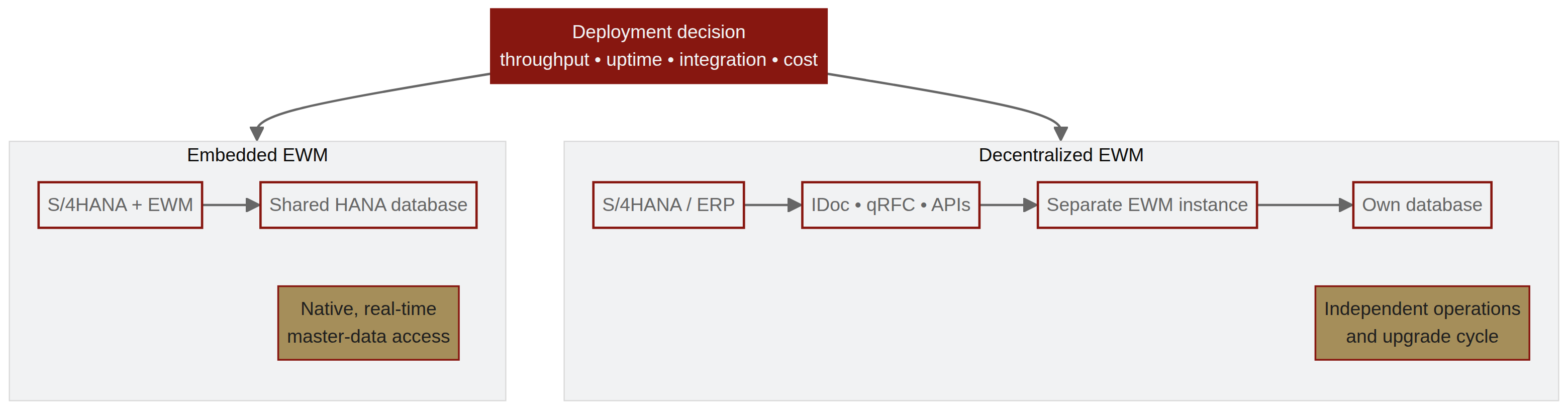
  • Deployment options:
    • Embedded EWM within the S/4HANA core
    • Decentralized EWM instance for high-volume or independent warehouse operations
  • SAP Fiori integration delivers a modern, role-based user experience for warehouse workers and managers

Common implementation pitfalls

Organizations frequently make the following mistakes when implementing SAP EWM:

  • Underestimating implementation complexity and process mapping needs
  • Treating EWM simply as an upgraded WM rather than reengineering processes to leverage advanced features
  • Inadequate data migration strategies
  • Insufficient user training and change management
  • Not fully exploiting EWM’s advanced capabilities (e.g., labor management, MFS)

When industries benefit most

Industries that typically gain the most from SAP EWM include:

  • Retail — due to complex, high-volume order fulfillment
  • Manufacturing — for component tracking and internal logistics
  • Third-party logistics (3PL) providers — for multi-client, high-throughput operations
  • Pharmaceuticals — for strict handling, batch traceability, and compliance

FAQ

  • What are the main differences between SAP EWM and SAP WM?

    • EWM offers advanced functionality such as labor management, yard management, and material flow control (MFS), which are missing or limited in WM.
  • How does SAP EWM integrate with SAP S/4HANA?

    • EWM can be embedded directly within the S/4HANA core or run as a decentralized instance connected to S/4HANA via APIs and integration technologies.
  • Which industries benefit most from SAP EWM?

    • Retail, manufacturing, third-party logistics (3PL), and pharmaceuticals often benefit due to complex handling and volume requirements.