Lupus Consulting

Top 10 SAP EWM Interview Questions and How to Answer Them

Hiring the right SAP Extended Warehouse Management (EWM) consultant is critical to optimized warehouse operations. This guide gives concise, interview-ready answers to the most common SAP EWM questions, covering deployment options, core processes, configuration points, integration challenges, and physical inventory handling.

Quick Answer

SAP EWM can be deployed embedded in SAP S/4HANA or as a decentralized system; EWM adds advanced capabilities beyond legacy Warehouse Management (WM) such as Labor Management, Material Flow System (MFS), Yard Management, and Process-Oriented Storage Control (POSC). Key interview topics include putaway strategies (using the Putaway Control Indicator, PACI), the difference between POSC and Layout-Oriented Storage Control (LOSC), the Post Processing Framework (PPF) for automated actions, master-data synchronization and Core Interface (CIF)/IDoc handling for integrations, and physical inventory methods including cycle counting and RF (radio frequency) framework support. Be ready to discuss troubleshooting, wave management, and MFS integration in practical scenarios.
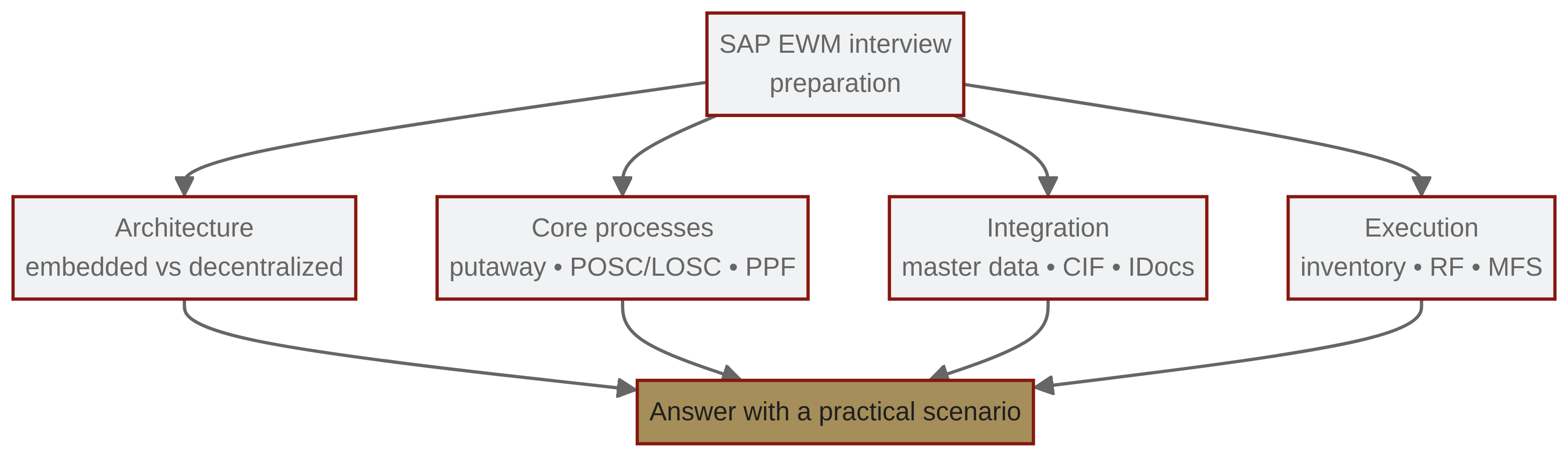
interview preparation for sap ewm

Top interview questions and model answers

  1. What are the primary deployment options for SAP EWM and their implications?
  • Model answer:
    • SAP EWM can be deployed as an embedded component within SAP S/4HANA or as a decentralized (standalone) system.
    • Embedded deployment (in S/4HANA) provides real-time data synchronization and a simplified landscape because ERP and EWM share the same system.
    • Decentralized deployment offers high performance and resilience; the warehouse can continue operating even if the main ERP is unavailable.
    • When answering, mention trade-offs around landscape complexity, performance, and failover behavior.
  1. Explain the key differences between SAP WM and SAP EWM.
  • Model answer:
    • SAP WM (Warehouse Management) is the legacy warehouse solution; SAP EWM (Extended Warehouse Management) is designed for complex, high-volume warehouse operations.
    • EWM includes advanced features not available in WM, such as Labor Management, Material Flow System (MFS), Yard Management, and Process-Oriented Storage Control (POSC).
    • WM is reaching end-of-life in many landscapes; EWM is the strategic solution for newer implementations, especially with S/4HANA.
  1. How do you handle complex putaway strategies in SAP EWM?
  • Model answer:
    • Putaway strategies are typically configured at the storage type level.
    • The system often uses the Putaway Control Indicator (PACI, Putaway Control Indicator) assigned in the product master to determine the storage type search sequence.
    • The search sequence can consider factors such as empty bins, bins near picking areas, or bulk storage locations.
    • Emphasize how configuration and product master settings work together to drive putaway logic.
  1. What is the difference between POSC and LOSC?
  • Model answer:
    • POSC (Process-Oriented Storage Control) defines the logical steps a Handling Unit must follow — for example: unloading, quality check, and then putaway.
    • LOSC (Layout-Oriented Storage Control) defines the physical path through the warehouse topology — for example: moving goods through intermediate bins, conveyors, or elevators based on the layout.
    • POSC governs the process flow; LOSC governs the physical routing and movement.
  1. Can you explain the role of PPF in SAP EWM processes?
  • Model answer:
    • PPF (Post Processing Framework) is the central component for triggering automated actions based on conditions.
    • Typical uses include automatically printing documents (e.g., warehouse orders), sending email notifications, or creating follow-on documents when certain events occur (for example, when a goods receipt is posted).
    • In an interview, give a short example of a PPF action you would configure and the triggering condition.
  1. What are the common challenges in integrating SAP EWM with SAP ERP?
  • Model answer:
    • Master-data synchronization is a primary challenge across both embedded and decentralized architectures.
    • In decentralized setups, ensure Core Interface (CIF) queues are monitored and clear; transactional data exchange often uses IDocs (Intermediate Documents) which must be monitored for errors (for example, deliveries).
    • In embedded setups, the emphasis shifts to correctly managing shared master data and handling S/4HANA-specific data models.
    • Mention monitoring and reconciliation practices as part of your troubleshooting approach.
  1. How does SAP EWM support physical inventory processes?
  • Model answer:
    • SAP EWM supports multiple physical inventory procedures: annual (snapshot) inventory, continuous inventory, cycle counting, and zero-stock checks.
    • Counting can be executed at the bin (storage bin) level or product level, and EWM integrates with the RF framework (radio frequency mobile framework) to support mobile counting and data capture.
    • When answering, note how RF integration streamlines on-the-floor counting and adjustments.

Preparation prompts (Questions 8–10)

  1. Troubleshooting scenarios — prepare to discuss
  • Be ready to describe specific troubleshooting scenarios you have handled or would handle, such as:
    • Resolving CIF/IDoc synchronization failures between ERP and decentralized EWM.
    • Diagnosing incorrect putaway or picking behavior caused by configuration conflicts.
    • Monitoring and resolving PPF action failures.
  • Interview tip: outline the problem, diagnostic steps, tools used (logs, queues, IDoc status), and the resolution.
  1. Wave management — prepare to discuss
  • Be prepared to explain wave management concepts: how waves are created, criteria for wave release, and how wave processing affects warehouse throughput and resource utilization.
  • Interview tip: discuss integration points with transportation planning or order prioritization where relevant.
  1. MFS (Material Flow System) integration — prepare to discuss
  • Be ready to discuss how EWM’s Material Flow System (MFS) integrates with automated material handling equipment, basic configuration considerations, and monitoring of MFS messages.
  • Interview tip: focus on how MFS relates to warehouse topology, LOSC, and operational reliability rather than low-level device details.

Common pitfalls for candidates

  • Relying on theory without practical configuration experience. Interviewers often probe for hands-on examples.
  • Not understanding S/4HANA-specific changes to EWM compared to older ECC-based EWM implementations.
  • Overlooking integration monitoring (CIF queues, IDocs, and PPF logs) when discussing end-to-end scenarios.

Related reading

FAQ

Q: What is SAP EWM in one sentence?
A: SAP Extended Warehouse Management (EWM) is a warehouse management solution designed for complex, high-volume warehouse operations that provides advanced functionality beyond legacy WM.

Q: What does MFS stand for and why is it important?
A: MFS stands for Material Flow System; it enables integration between EWM and automated material handling equipment, supporting automated routing and control based on warehouse topology.

Q: What is the RF framework?
A: The RF framework (radio frequency framework) supports mobile devices for warehouse workers, enabling tasks such as picking, putaway, and physical inventory counting directly on handheld terminals.

Q: When should I mention PPF in an interview?
A: Mention PPF when discussing automation of document printing, notifications, or follow-on processes — describe a condition, the action, and the business benefit.

Related Articles