SAP
AMS
Atlassian
Produkte
Industrien & Expertise
BEST-SHORING
Wissen
SALESFORCE


As the December 31, 2027 deadline for the end of mainstream maintenance for SAP ECC 6 (EHP 6-8) approaches, the pressure on organizations to modernize their ERP landscapes has reached a critical point. The valantic SAP Study 2026 reveals that the transformation of SAP landscapes has definitively entered the implementation and stabilization phase, with around 70 percent of surveyed companies currently migrating to SAP S/4HANA or having already completed the process.
However, simply moving to a new system is no longer enough. The real focus has shifted to how these systems are architected, making the clean core strategy the most crucial element of modern SAP deployments.
The clean core strategy aims to keep the core of the SAP system clean by avoiding direct modifications to the standard code. Approximately 80% of business processes run almost identically across companies and offer little competitive differentiation. These standard processes are mapped in SAP S/4HANA and serve as the stable, reliable core of the ERP system.
The remaining 20% of processes, which require company-specific customization, should be implemented outside of the SAP S/4HANA core. By decoupling these extensions, organizations can innovate faster without compromising the stability of their ERP foundation.
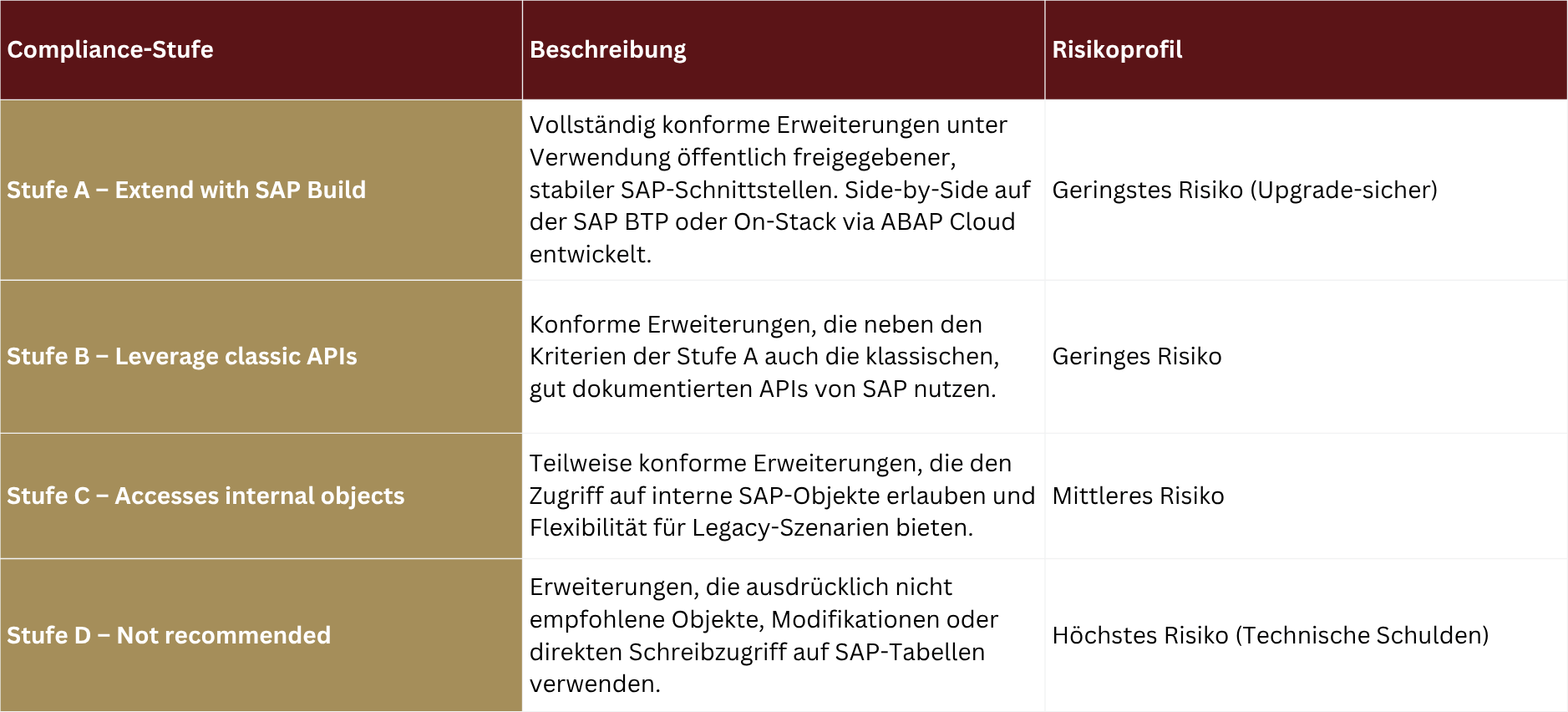
To clarify extensibility decisions and simplify qualification criteria, SAP has evolved its framework into a four-level maturity model based on architectural integrity and upgrade safety:
Organisationen betrachten Clean Core oft als technische Notwendigkeit, aber es liefert erhebliche geschäftliche Vorteile:
Die valantic SAP-Studie 2026 hebt eine deutliche Verschiebung bei den Bereitstellungspräferenzen hervor. SAP Cloud ERP Private hat sich zum dominierenden Bereitstellungsmodell entwickelt und wird von 64 % der Organisationen bevorzugt. Dies bestätigt, dass die Mehrheit der Unternehmen eine kontinuierliche, kontrollierte Transformation favorisiert, insbesondere in Industriesektoren wie der diskreten Fertigung und Logistik.
Was die Migrationsstrategien betrifft, so bleibt die erweiterte Brownfield/Bluefield-Konvertierung zwar der am häufigsten genutzte Ansatz (47 %), aber traditionelle Brownfield-Migrationen gewinnen an Zugkraft (18 %). Diese Kombination aus Brownfield und Private Cloud entwickelt sich für viele Unternehmen zu einer neuen "ERP-Komfortzone".
Der Go-Live von SAP S/4HANA ist nicht mehr die Ziellinie; er markiert den Beginn einer kontinuierlichen Transformation. Die Aufgabe besteht nun darin, S/4HANA strategisch zu nutzen, um Prozesse zu modernisieren, Daten effektiver auszuwerten und Innovationen zu skalieren. Durch die Übernahme der Clean Core Strategie stellen Organisationen sicher, dass ihre ERP-Landschaft ein Katalysator für Wachstum bleibt und nicht zu einem Engpass für Veränderungen wird.