SAP
AMS
Atlassian
Products
Industries & Expertise
BEST-SHORING
Knowledge Base
SALESFORCE


As the December 31, 2027 deadline for the end of mainstream maintenance for SAP ECC 6 (EHP 6-8) approaches, the pressure on organizations to modernize their ERP landscapes has reached a critical point. The valantic SAP Study 2026 reveals that the transformation of SAP landscapes has definitively entered the implementation and stabilization phase, with around 70 percent of surveyed companies currently migrating to SAP S/4HANA or having already completed the process.
However, simply moving to a new system is no longer enough. The real focus has shifted to how these systems are architected, making the clean core strategy the most crucial element of modern SAP deployments.
The clean core strategy aims to keep the core of the SAP system clean by avoiding direct modifications to the standard code. Approximately 80% of business processes run almost identically across companies and offer little competitive differentiation. These standard processes are mapped in SAP S/4HANA and serve as the stable, reliable core of the ERP system.
The remaining 20% of processes, which require company-specific customization, should be implemented outside of the SAP S/4HANA core. By decoupling these extensions, organizations can innovate faster without compromising the stability of their ERP foundation.
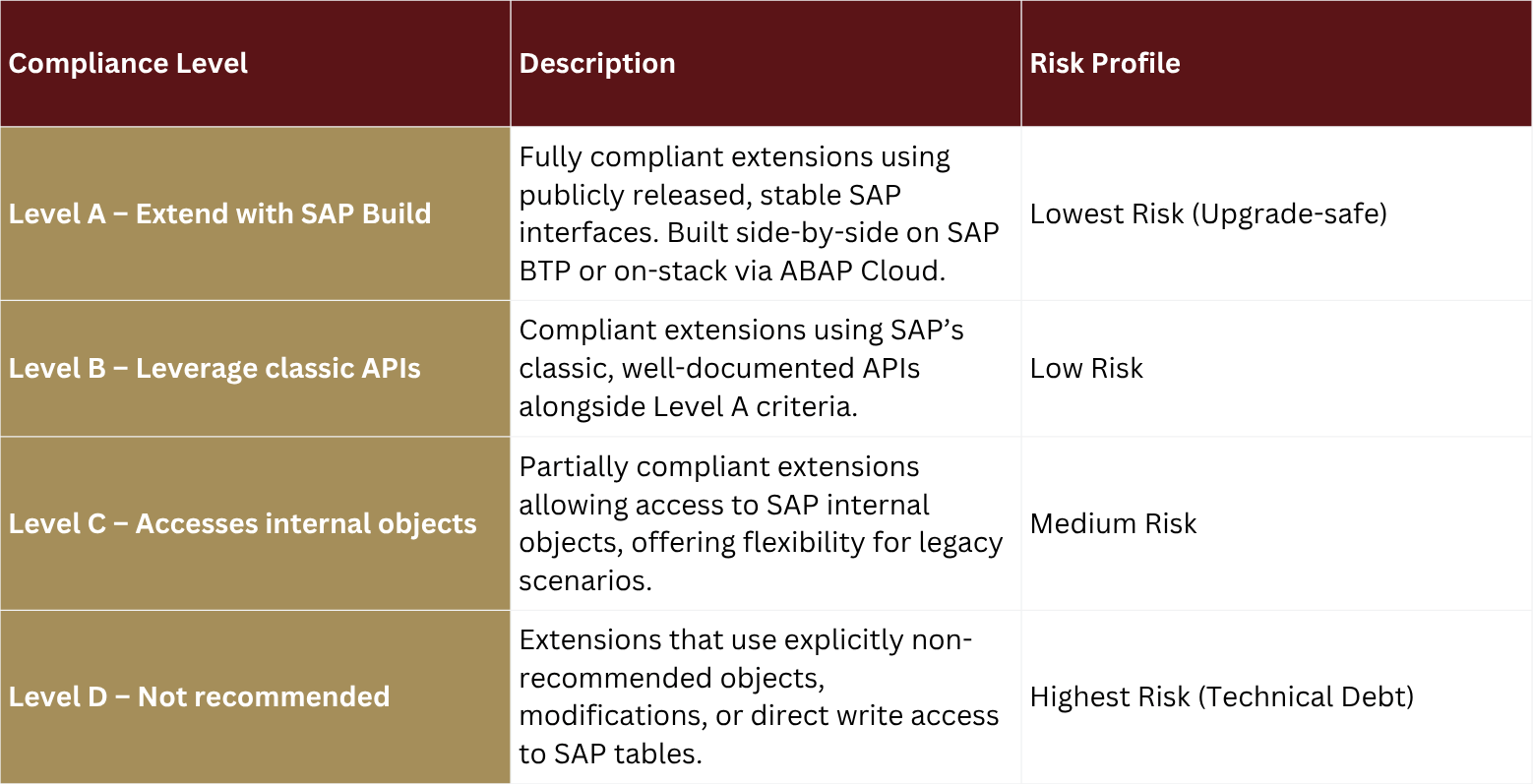
To clarify extensibility decisions and simplify qualification criteria, SAP has evolved its framework into a four-level maturity model based on architectural integrity and upgrade safety:
Organizations often view clean core as a technical necessity, but it delivers substantial business benefits:
The valantic SAP Study 2026 highlights a clear shift in deployment preferences. SAP Cloud ERP Private has become the dominant deployment model, preferred by 64% of organizations. This confirms that the majority of companies favor a continuous, controlled transformation, particularly in industrial sectors like discrete manufacturing and logistics.
Regarding migration strategies, while extended brownfield/bluefield conversion remains the most frequently used approach (47%), traditional brownfield migrations are gaining traction (18%). This combination of brownfield and private cloud is developing into a new "ERP comfort zone" for many enterprises.
The go-live of SAP S/4HANA is no longer the finish line; it marks the start of a continuous transformation. The task now is to use S/4HANA strategically to modernize processes, evaluate data more effectively, and scale innovations. By embracing the clean core strategy, organizations ensure their ERP landscape remains a catalyst for growth rather than a bottleneck for change.


SAP spent decades teaching companies how to run their operations through software. Now,