SAP
AMS
Atlassian
Products
Industries & Expertise
BEST-SHORING
Knowledge Base
SALESFORCE


SAP spent decades teaching the world's largest companies how to run their operations through software. Now, it wants those operations to run on their own, with agentic AI at the center. At SAP Sapphire 2026, the company unveiled the "Autonomous Enterprise," its most aggressive repositioning in a generation, arguing that the future of enterprise software isn't better interfaces or smarter assistants, but AI agents that handle operational work end-to-end.
Enterprise AI has progressed rapidly from rule-based automation to machine learning and generative AI. Today, the focus is on intelligent, goal-driven systems capable of reasoning across enterprise data, coordinating workflows, and executing decisions with minimal human input.
Unlike traditional chatbots that are limited to reactive responses and scripted actions, modern ERP environments demand AI that understands business entities, relationships, and governance rules. SAP Joule Agentic AI enables this shift by embedding agentic intelligence directly into ERP workflows to understand context and take action.
"For the mission-critical processes of our customers, 'almost right' just isn't good enough," noted SAP CEO Christian Klein. "By uniting SAP Business AI Platform with SAP Autonomous Suite, we anchor AI agents in the business processes, data and governance so they can deliver accurate, compliant and secure outcomes".
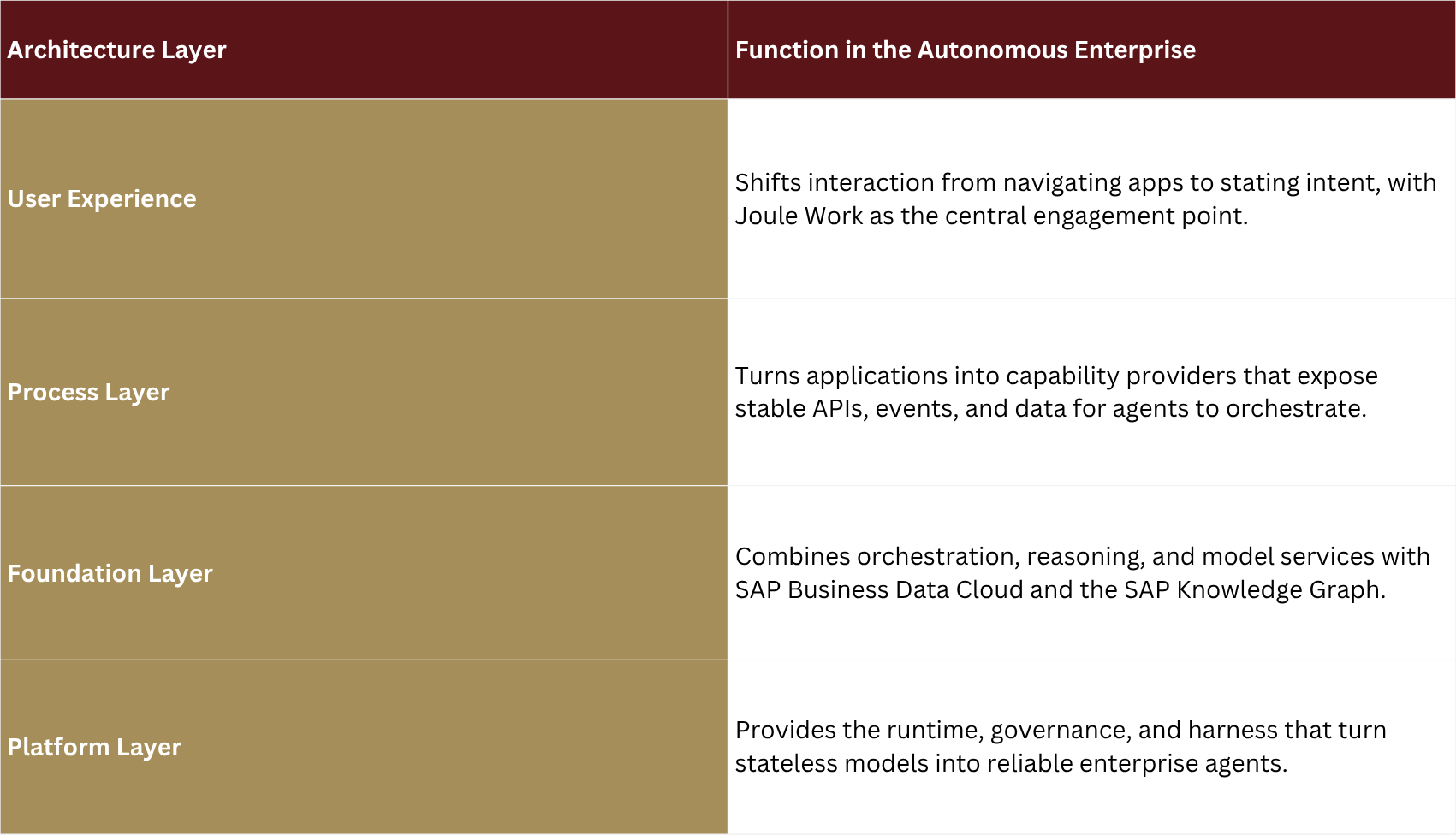
To move beyond isolated AI features and build an enterprise that reasons, learns, and acts as one, SAP introduced its AI-Native North Star Architecture. This foundation pairs two complementary paths: the deterministic path, which keeps the predictable, rule-based execution that compliance depends on, and the probabilistic, AI-native path, which adds reasoning that learns from data and experience.
The architecture delivers this through four reimagined layers that together form a cognitive core:
The SAP Autonomous Suite will deploy more than 50 domain-specific Joule Assistants and orchestrate a subset of over 200 specialized agents to execute precise tasks.
For example, the new Autonomous Close Assistant can compress the financial close process from weeks to days by automating journal entries, reconciliation, and error resolution across the entire process. In Q1 2026, SAP's Cash Management Agent became generally available, reducing time spent on manual cash positioning by up to 80% by autonomously analyzing daily bank statements and automating reconciliations.
In supply chain operations, organizations are moving from isolated copilots to coordinated agent-to-agent workflows. Supplier reliability agents monitor vendor risk while workforce orchestration agents align labor capacity with demand. Procurement agents execute sourcing decisions, and production planning agents dynamically rebalance schedules in response to changing conditions.
SAP is betting that the winning layer in enterprise AI is governance—the operational context, process logic, and compliance infrastructure that determines whether an autonomous agent can be trusted with critical business decisions.
Every action an agent takes in the Autonomous Suite is fully logged, providing "traceability by design." Trust is engineered in, not bolted on. Agents become first-class principals with their own agent identity, scoped to a bounded subset of permissions and audited like any enterprise actor.
As organizations navigate the new supply chain paradigm and permanent disruptions, the future will be defined by the ability to operate the enterprise as a connected, adaptive, and increasingly autonomous system.

ESG reporting isn't just a sustainability challenge—it's an ERP challenge. Traditional