SAP S/4HANA Migration in 2026: Brownfield vs. Greenfield vs. Bluefield

As the December 31, 2027 deadline for SAP ECC 6 mainstream maintenance draws nearer, the conversation around SAP S/4HANA has definitively shifted from whether to migrate to how to migrate. For years, Chief Information Officers and IT directors have debated the merits of two primary approaches: the fresh start of a Greenfield implementation versus the pragmatic upgrade of a Brownfield conversion.

However, as we move through 2026, a third option has risen to prominence. The Bluefield (or hybrid) approach is rapidly becoming the strategy of choice, offering a middle ground that balances innovation with risk mitigation. In this article, we will break down the differences, pros, and cons of each approach to help you determine the best path for your organization.

The Greenfield Approach: A Fresh Start

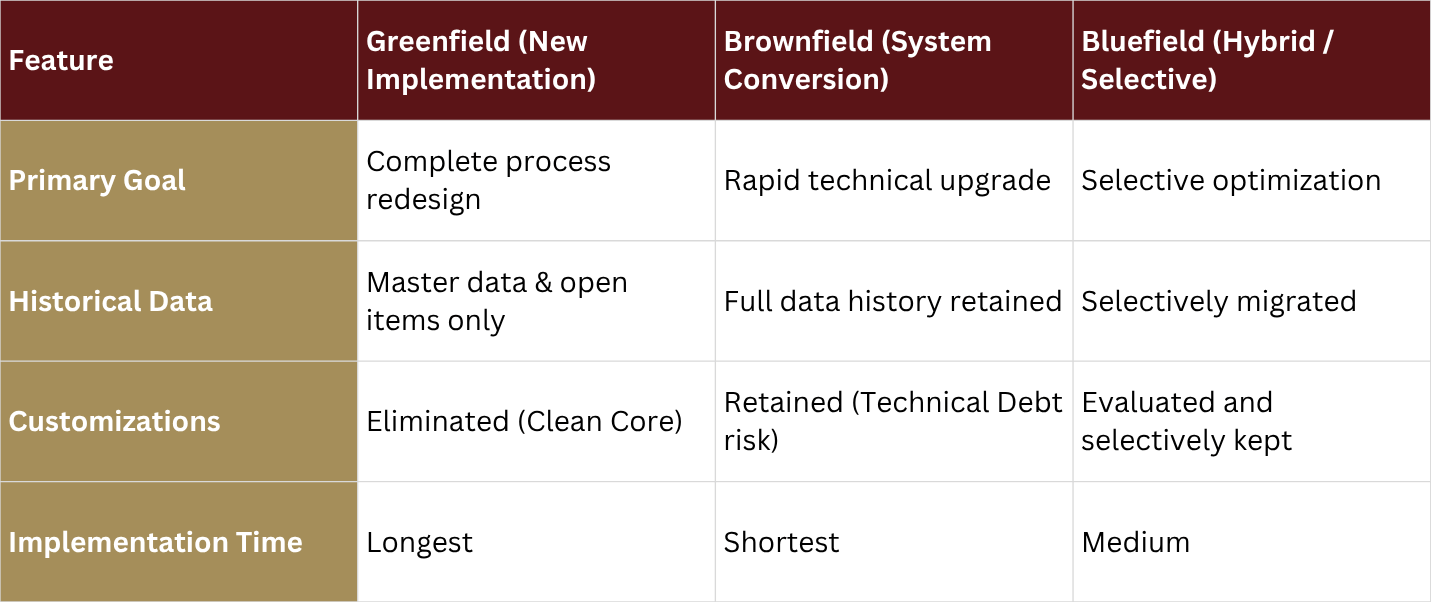
The Greenfield approach treats the SAP S/4HANA migration as a completely new implementation. Organizations set up a brand-new ERP landscape from scratch, leaving behind decades of legacy customizations, workarounds, and technical debt.

In this scenario, only essential master data and open transactional data are migrated to the new system.

Pros of Greenfield

  • Process Optimization: It forces the business to re-evaluate and redesign processes based on SAP standard best practices.
  • Clean Core: It is the easiest way to establish a "clean core" architecture, which simplifies future upgrades and cloud readiness.
  • Full S/4HANA Potential: Organizations can immediately leverage the full suite of SAP S/4HANA innovations, including embedded AI and advanced analytics.

Cons of Greenfield

  • High Cost and Effort: Building a system from scratch requires significant time, budget, and internal resource allocation.
  • Change Management: Adopting entirely new processes requires extensive user training and organizational change management.
  • Loss of Historical Context: Valuable historical data is often left behind in legacy systems, requiring separate archiving solutions.

The Brownfield Approach: System Conversion

The Brownfield approach is a technical system conversion. It upgrades the existing SAP ECC environment to SAP S/4HANA while retaining the company's existing business processes, configurations, custom code, and historical data.

Pros of Brownfield

  • Speed and Cost: It is generally faster and more cost-effective than a Greenfield implementation because the fundamental system architecture remains intact.
  • Minimal Disruption: Users experience less disruption as familiar processes and interfaces are largely retained.
  • Historical Data Retention: All historical data is carried over into the new system automatically.

Cons of Brownfield

  • Technical Debt: Legacy customizations and inefficient processes are carried over, potentially limiting the system's agility and innovation capabilities [3].
  • Missed Opportunities: Organizations may fail to utilize the advanced features of S/4HANA if they simply replicate old ECC processes in the new environment.
  • Testing Complexity: Extensive testing is required to ensure that decades-old custom code functions correctly in the S/4HANA architecture [3].

The Bluefield Approach: The Hybrid Middle Ground

Also known as Selective Data Transition, the Bluefield approach combines the best elements of both Greenfield and Brownfield. It allows organizations to selectively migrate specific data, company codes, and processes while leaving obsolete data and inefficient customizations behind.

According to industry trends for 2026, Bluefield is outpacing Greenfield as the preferred method, as companies seek meaningful change delivered pragmatically.
Pros of Bluefield

  • Selective Optimization: Companies can redesign broken processes (Greenfield-style) while retaining processes that work well (Brownfield-style).
  • Controlled Data Scope: Organizations can choose exactly how much historical data to migrate, reducing the database footprint while maintaining compliance.
  • Phased Rollouts: It supports complex scenarios, such as consolidating multiple ERP systems or managing corporate carve-outs during the migration.

Cons of Bluefield

  • Tool Dependency: This approach heavily relies on specialized third-party software and expert consulting partners to execute the selective data transition.
  • Complexity in Planning: Deciding exactly what to keep and what to discard requires meticulous planning and strong business alignment.

Comparing the Approaches

sap migration

Which Path is Right for You in 2026?

The right migration strategy depends heavily on your organization's current state and future goals.

  • Choose Greenfield if your current SAP system is heavily customized, outdated, or if you are undergoing a massive business model transformation.
  • Choose Brownfield if your current processes are highly optimized, your custom code is well-documented, and your primary goal is a rapid, low-risk transition to the cloud.
  • Choose Bluefield if you have a complex landscape (e.g., multiple ERP instances), need to consolidate systems, or want to modernize specific processes without the disruption of a full reimplementation.

As 2026 progresses, the Bluefield approach is proving that organizations do not have to choose between innovation and stability. By taking a selective approach, businesses can build an agile, AI-ready S/4HANA foundation while respecting the constraints of time, budget, and operational continuity.

More SAP related Articles and Insights

clean core

The SAP S/4HANA Clean Core Strategy: Why 2026 is the Year of Implementation and Stabilization

With the 2027 deadline for SAP ECC support looming, companies are accelerating their S/

SAP ERP

The Dawn of the Autonomous Enterprise: How SAP’s Agentic AI is Rewriting the ERP Operating Model

SAP spent decades teaching companies how to run their operations through software. Now,

SAP ECC 2027: Was Unternehmen jetzt tun sollten

SAP ECC 2027: What Companies Can Still Realistically Achieve in 2026

The end of SAP ECC mainstream maintenance is getting closer. For many companies, 2026 i