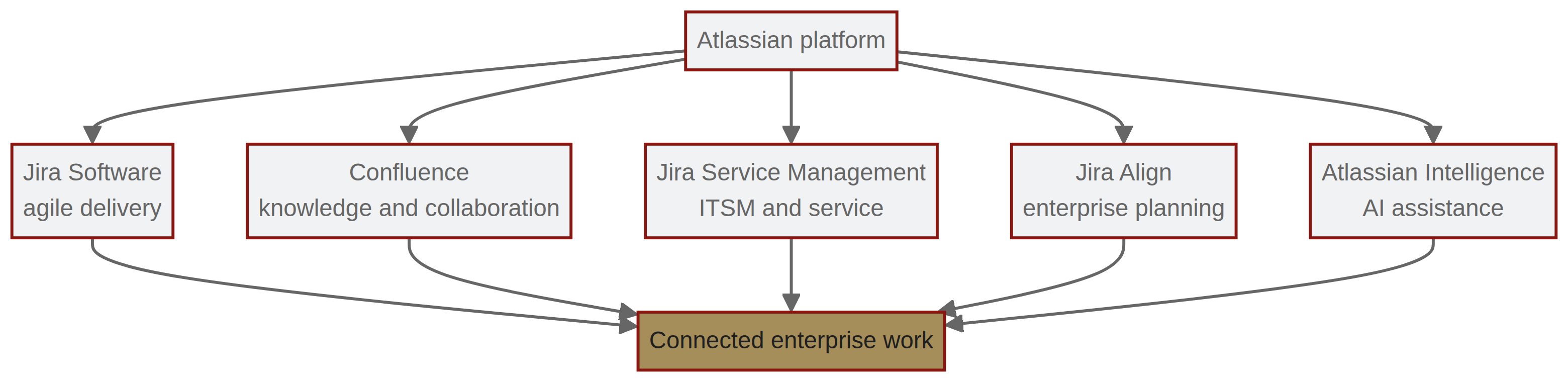
The Atlassian product portfolio
The ecosystem centers on a core set of enterprise applications:
- Jira Software — Agile project management and issue tracking for Scrum and Kanban teams.
- Confluence — Team workspace and wiki for documentation and a single source of truth.
- Jira Service Management (JSM) — IT Service Management (ITSM) solution; JSM is described as ITIL‑certified (ITIL = Information Technology Infrastructure Library).
- Bitbucket — Git-based code repository and CI/CD (Continuous Integration/Continuous Delivery) tool that integrates with Jira.
- Jira Align — Enterprise agile planning platform aligned to SAFe (Scaled Agile Framework) that connects strategic goals with team-level execution.
- Atlassian Intelligence (Rovo) — AI layer integrated across the platform for task automation, content summarization and improved search.
(Each product above is presented as described in the source material; organizations should validate current capabilities against Atlassian product documentation.)
The shift to cloud and licensing
A major platform change is the end of support for Server products. Atlassian officially ended support for Server products as of February 15, 2024. Enterprises now select between Atlassian Cloud or Data Center (Data Center has an end‑of‑life date of March 2029).
Atlassian Cloud licensing tiers (as described in the source):
- Free — For small teams (up to 10 users).
- Standard — For growing teams who need user management and increased storage.
- Premium — For scaling organizations that require advanced features (e.g., Advanced Roadmaps), 24/7 support and unlimited storage.
- Enterprise — For large corporations needing global scale, multiple instances, centralized user billing and strict data residency controls.
Choose the tier that matches scale, governance and compliance requirements; migration and governance planning are important when moving from Server or Data Center to Cloud.
Data residency and GDPR in the DACH region
Data Residency options allow customers on Standard, Premium and Enterprise plans to pin in‑scope product data to specific geographic locations, including the EU (Frankfurt). For DACH enterprises, the ability to locate data in the EU is a key control for addressing GDPR (General Data Protection Regulation) and local corporate compliance rules.
Note: Data Residency is an option described in the source; organizations should verify which products and data types are in scope for residency and consult legal/compliance teams when relying on residency controls.
Common pitfalls and migration considerations
Common issues organizations encounter during migration or large‑scale Atlassian adoption:
- Underestimating migration complexity: moving from Server to Cloud can create downtime and risk data integrity if not planned properly.
- App compatibility and data cleanup: third‑party apps and custom data often require remediation before cutover.
- Over-customization: heavy custom workflows, schemes and configurations (especially in Jira) can become unmanageable and impede upgrades or migration.
- Governance and change management gaps: lacking controls and training leads to inconsistent workflows and user resistance.
- Security and compliance oversight: not fully leveraging Atlassian’s security, compliance features or Data Residency options can raise regulatory risk for DACH organizations.
Plan migrations with discovery, app compatibility testing, identity mapping, staged cutovers and a governance model to mitigate these risks.