SAP
AMS
Atlassian
Products
Industries & Expertise
BEST-SHORING
Knowledge Base
SALESFORCE

The pressure on organizations to demonstrate environmental, social, and governance (ESG) accountability has never been greater. Regulatory frameworks like the European Union's Corporate Sustainability Reporting Directive (CSRD), which became effective in January 2025, are elevating sustainability reporting to the same rigor and auditability as financial reporting. Investors, customers, and employees increasingly demand transparency on carbon footprints, supply chain ethics, and social impact. However, many organizations are discovering a fundamental truth: ESG reporting is not just a sustainability challenge—it is an ERP challenge.
Traditional sustainability management tools, often siloed from core business systems, struggle to provide the granular, transaction-level data required for credible ESG reporting. Carbon emissions cannot be accurately measured at an aggregate level alone; they must be traced to individual business transactions, products, and profit centers. This level of precision requires deep integration with the systems that record every purchase order, production run, shipment, and sale—in other words, your Enterprise Resource Planning (ERP) system. For organizations running on SAP, this realization opens a transformative opportunity: to embed sustainability into the financial and operational backbone of the enterprise.
Most organizations begin their ESG journey with standalone sustainability software or spreadsheet-based carbon calculators. These tools collect data from various sources—utility bills, supplier questionnaires, logistics reports—and apply emission factors to estimate the organization's carbon footprint. While this approach can satisfy basic disclosure requirements, it has critical limitations when regulatory and stakeholder expectations rise.
The first limitation is data granularity. Aggregate estimates do not reveal which specific products, business units, or customer orders are carbon-intensive. Without transaction-level visibility, organizations cannot make informed decisions about where to focus decarbonization efforts or how to allocate carbon costs to profit centers. The second limitation is auditability. Financial statements are audited because every number can be traced back to a source transaction with a clear audit trail. Sustainability data collected outside the ERP lacks this rigor, making it vulnerable to scrutiny and greenwashing accusations. The third limitation is integration. When sustainability data lives in a separate system, it cannot be easily correlated with financial performance, supply chain operations, or strategic planning. Sustainability remains a compliance exercise rather than a driver of business value.
The CSRD explicitly addresses these shortcomings by requiring companies to apply the same level of internal controls, double-entry bookkeeping principles, and audit standards to ESG data as they do to financial data. This regulatory shift makes it clear: sustainability reporting must be integrated into the ERP.
Recognizing this imperative, SAP introduced SAP Green Ledger, a solution designed to bring financial-grade precision to carbon accounting. SAP Green Ledger is an application built on the SAP Business Technology Platform (SAP BTP) that integrates seamlessly with SAP S/4HANA Cloud, the organization's financial and operational core. It enables organizations to track, measure, and report carbon emissions at the transaction level, aligning carbon data with financial data in a unified ledger.
The concept of a "green ledger" mirrors the traditional financial ledger. Just as every financial transaction is recorded with debits and credits, every business activity that generates or reduces carbon emissions is recorded in the green ledger. When a company purchases raw materials, the associated Scope 3 emissions are captured. When a factory produces goods, the Scope 1 and Scope 2 emissions from energy consumption are logged. When products are sold, the carbon footprint can be allocated to customers or profit centers. This transaction-level granularity transforms carbon from an abstract metric into a tangible, manageable dimension of business performance.
SAP Green Ledger supports Scope 1, 2, and 3 emissions in alignment with the Greenhouse Gas (GHG) Protocol. Scope 1 covers direct emissions from owned or controlled sources, such as company vehicles and on-site combustion. Scope 2 covers indirect emissions from purchased electricity, heat, or steam. Scope 3, the most complex category, covers all other indirect emissions across the value chain, including purchased goods, transportation, and product use. By integrating with SAP S/4HANA's procurement, production, and logistics modules, SAP Green Ledger can automatically capture emissions data from these activities without requiring manual data entry.
An ERP-centric approach to ESG reporting offers several strategic advantages that go beyond regulatory compliance. These advantages stem from the fact that the ERP system is the single source of truth for business transactions, making it the ideal foundation for sustainability management.
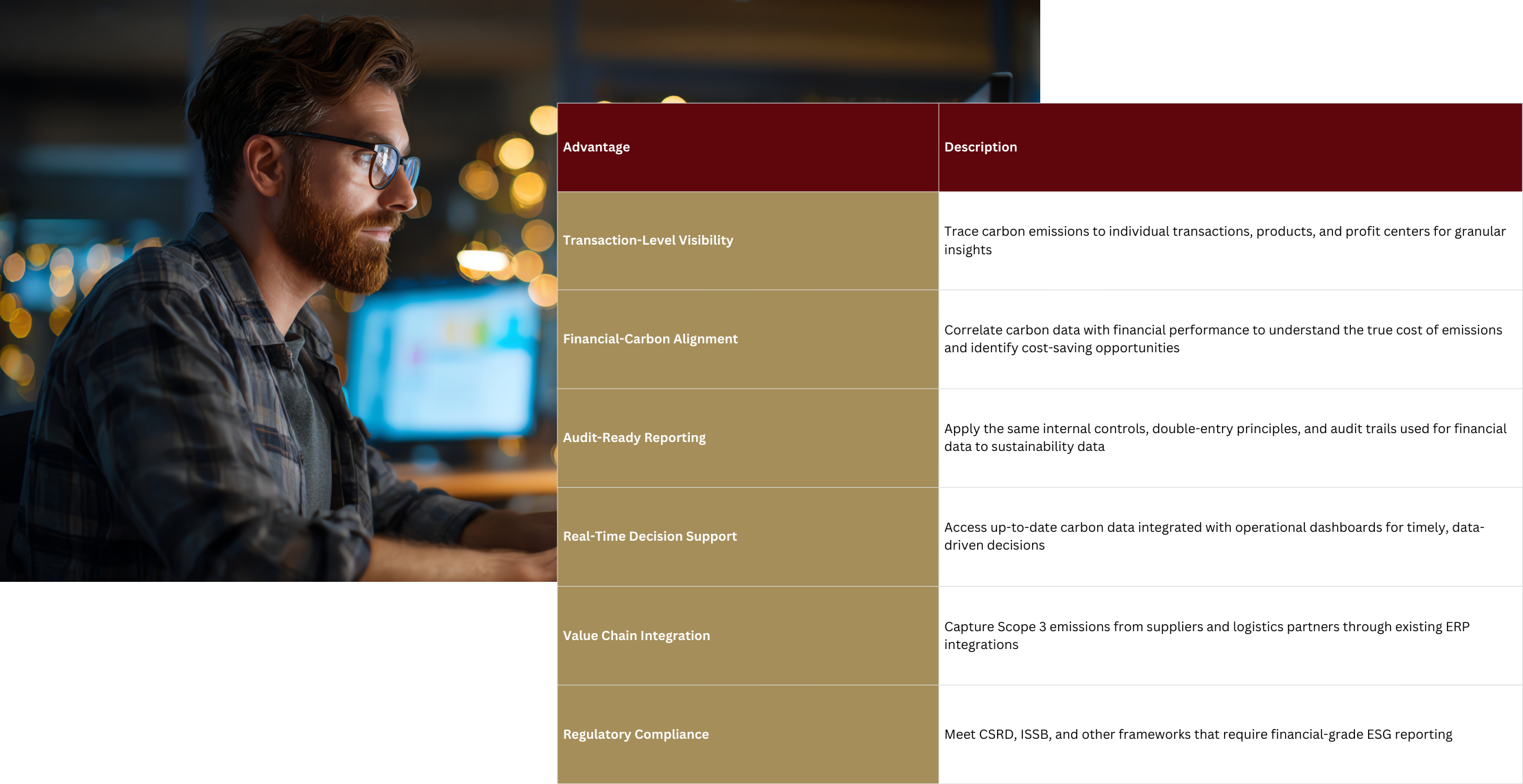
One of the most powerful aspects of this approach is the ability to allocate carbon costs to business dimensions such as profit centers, cost centers, products, or customers. In traditional financial accounting, costs are allocated to understand profitability. With SAP Green Ledger, the same logic applies to carbon. Organizations can calculate the carbon intensity of each product line, identify which customers have the highest carbon footprint, and make strategic decisions about pricing, sourcing, and product design based on both financial and environmental impact.
Furthermore, an ERP-centric approach enables carbon budgeting and forecasting. Just as organizations set financial budgets and track variances, they can set carbon budgets for business units and monitor performance against targets. This transforms sustainability from a retrospective reporting exercise into a proactive management discipline.
While SAP Green Ledger provides the accounting engine for carbon data, SAP Sustainability Control Tower serves as the integration and orchestration layer. The Control Tower connects SAP S/4HANA with other SAP sustainability solutions, such as SAP Sustainability Footprint Management (for product-level carbon footprints) and SAP ESG Reporting Tools (for disclosure management). It also integrates with third-party data sources, such as utility providers, logistics partners, and supplier sustainability platforms.
The Control Tower's role is to ensure that carbon data flows seamlessly from operational systems into the green ledger, where it can be accounted for, allocated, and reported. It also provides analytics and dashboards that give sustainability managers and executives real-time visibility into the organization's carbon performance. By centralizing sustainability data management within the SAP ecosystem, the Control Tower eliminates the need for manual data consolidation and reduces the risk of errors.
Implementing an ERP-centric approach to ESG reporting is a strategic initiative that requires careful planning and cross-functional collaboration. Based on best practices observed in organizations that have successfully integrated sustainability into their SAP environments, we recommend a four-step framework.
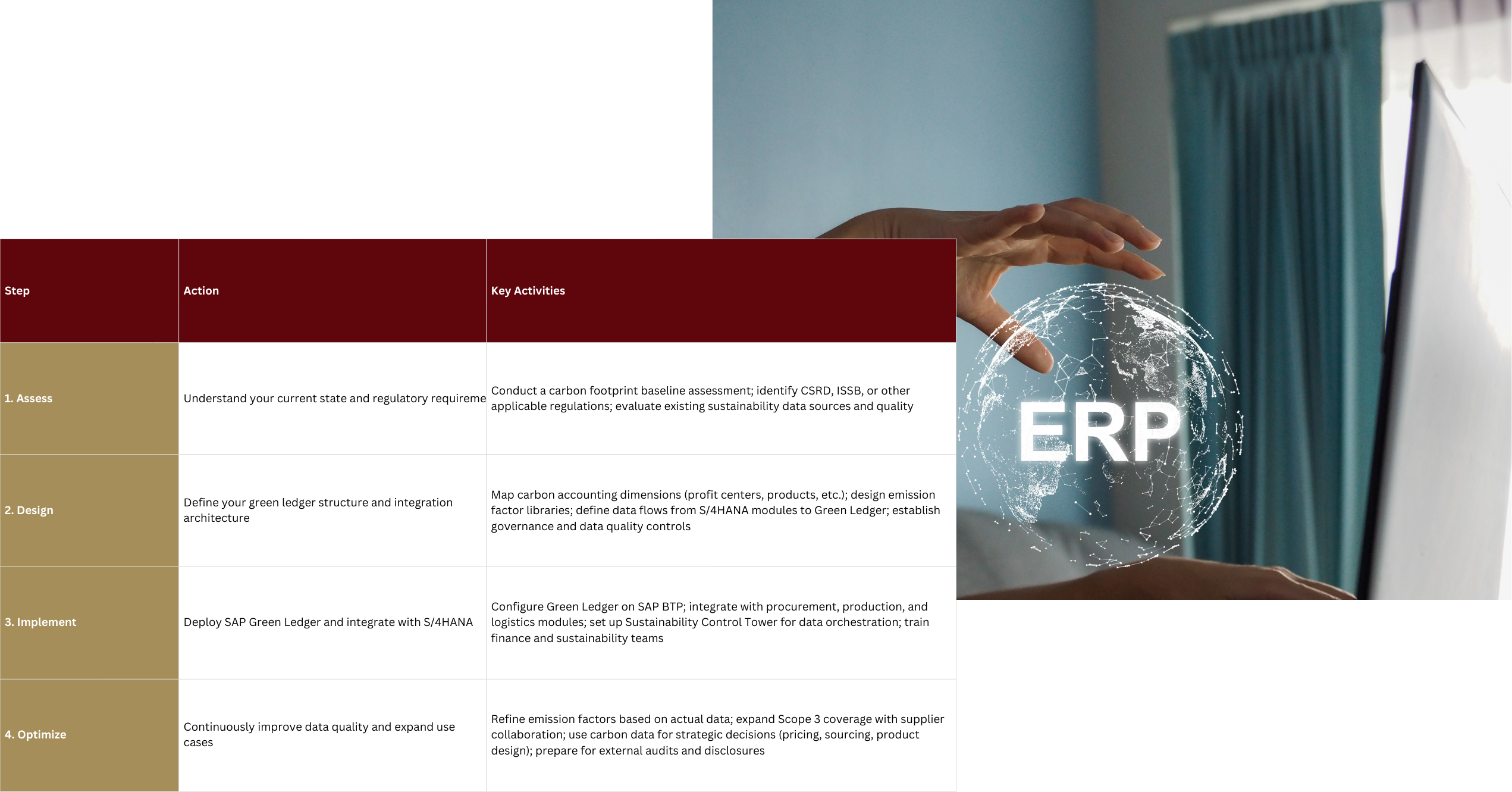
The Assess phase is critical for setting realistic expectations and securing executive sponsorship. Organizations should conduct a materiality assessment to identify which ESG topics are most relevant to their business and stakeholders. For most industrial and consumer goods companies, carbon emissions (climate change) will be a top priority, but other topics such as water use, waste, and social factors may also be material. Understanding the regulatory landscape is equally important. The CSRD applies to large EU companies and non-EU companies with significant EU operations, but other jurisdictions are introducing similar requirements. Organizations should map their reporting obligations and timelines early.
The Design phase involves translating business requirements into a technical architecture. A key decision is how to structure the green ledger's chart of accounts. Should carbon be tracked by legal entity, profit center, product, or customer? The answer depends on the organization's reporting needs and strategic priorities. Organizations should also establish a library of emission factors—the coefficients used to convert activity data (e.g., kilowatt-hours of electricity, kilometers traveled) into carbon emissions. While generic emission factors are available from databases like the GHG Protocol, organizations can improve accuracy by using supplier-specific or region-specific factors.
The Implement phase is where the technical integration happens. SAP Green Ledger is deployed as a cloud application on SAP BTP and connected to SAP S/4HANA via standard APIs. Configuration includes setting up the carbon accounting rules, defining data extraction logic from S/4HANA modules, and establishing user roles and permissions. Training is essential during this phase, as both finance teams (who will manage the green ledger) and sustainability teams (who will interpret the data) need to understand the new workflows.
The Optimize phase is ongoing. As organizations gain experience with carbon accounting, they will identify opportunities to refine their approach. For example, initial implementations may rely on industry-average emission factors, but over time, organizations can work with suppliers to obtain primary data, improving accuracy. Organizations can also expand the use of carbon data beyond compliance reporting. For instance, carbon intensity metrics can be incorporated into product pricing models, supplier scorecards, and capital investment decisions.
While regulatory compliance is often the initial driver for ESG reporting, forward-thinking organizations recognize that sustainability data can be a source of competitive advantage. Customers, particularly in B2B markets, are increasingly requesting product-level carbon footprints to calculate their own Scope 3 emissions. Organizations that can provide accurate, auditable carbon data will win business. Investors are using ESG performance as a criterion for capital allocation, and companies with strong sustainability credentials can access lower-cost capital. Employees, especially younger generations, want to work for organizations that align with their values, and transparent ESG reporting is a key signal of corporate responsibility.
An ERP-centric approach to ESG reporting, enabled by solutions like SAP Green Ledger, positions organizations to capture these opportunities. By embedding sustainability into the financial and operational core of the enterprise, organizations can manage carbon with the same rigor as cash, make data-driven decisions that balance profitability and environmental impact, and build trust with stakeholders through transparent, auditable reporting.
The journey to a sustainable enterprise is not a one-time project but a continuous transformation. It requires leadership commitment, cross-functional collaboration, and a willingness to rethink traditional business processes. However, for organizations running on SAP, the tools and frameworks are now available to make this transformation a reality. ESG is an ERP challenge—and SAP is ready to help you solve it.


A connected enterprise is what we all strive for. But how can silos between Atlassian a