SAP
AMS
Atlassian
Products
Industries & Expertise
BEST-SHORING
Knowledge Base
SALESFORCE


SAP Cloud ALM is becoming SAP's strategic ALM platform. However, the transition from SAP Solution Manager is not a simple tool swap. This article explains what is truly changing and which questions companies should clarify before 2027.
SAP Cloud ALM is increasingly coming into focus for many companies. The reason is clear: SAP Solution Manager 7.2 will only remain in regular mainstream maintenance until the end of 2027. SAP recommends that customers complete the transition to SAP Cloud ALM before the end of 2027.
For SAP teams, this means their current ALM strategy must be reviewed. However, this is not just about which tool will be used in the future. The shift from SAP Solution Manager to SAP Cloud ALM changes how companies implement, operate, monitor, and develop their SAP landscapes.
The most important point upfront: SAP Cloud ALM is not a pure 1:1 replacement for SAP Solution Manager. It is a new, cloud-native ALM platform with a different approach. Those who want to prepare for the transition properly should therefore not only compare features but also review their own processes, system landscapes, and operational requirements.
For many years, SAP Solution Manager was the central tool for Application Lifecycle Management in SAP landscapes. Many companies use it for monitoring, Change Request Management, test management, IT Service Management, process documentation, or technical operational processes.
For SAP Solution Manager 7.2, SAP lists supported application areas including Application Operations, Business Process Monitoring, Change Control Management, Custom Code Management, IT Service Management, Job Scheduling Management, Landscape Management, Process Management, and Test Suite.
This breadth is also the reason why the transition must be well planned. Companies have often integrated Solution Manager deeply into their operational and governance processes. If this platform is eventually replaced or reduced, it affects not only IT. It affects project teams, business departments, Basis teams, support organizations, and external service providers.
SAP Cloud ALM follows a different approach than SAP Solution Manager. While Solution Manager was built as a comprehensive on-premise ALM platform for classic and hybrid SAP landscapes, SAP Cloud ALM is cloud-native, more standardized, and more strongly aligned with modern SAP cloud and hybrid scenarios.
SAP describes Cloud ALM as a platform for implementation, operations, and service. The focus includes SAP Activate, project and task management, test management, as well as cloud operations with monitoring for integration, jobs, health, user experience, and business processes.
This means: SAP Cloud ALM is not simply "Solution Manager in the cloud." It is a strategic shift toward a leaner, more standardized ALM model.
The transition to SAP Cloud ALM changes several levels simultaneously: architecture, operations, functional scope, governance, and integration.
SAP Solution Manager is operated within the company's own system landscape. Companies must organize installation, updates, maintenance, and technical care themselves. SAP Cloud ALM, on the other hand, is provided as a cloud service.
This reduces the technical operational effort for the ALM platform itself. At the same time, however, the responsibility changes: companies must deal more intensively with cloud connectivity, authorizations, data flows, and integration into existing tools.
For SAP teams, this is a clear shift in perspective. It is less about operating a large central platform internally. It is more about meaningfully integrating SAP Cloud ALM into the existing system and tool landscape.
SAP Solution Manager offers a very broad functional scope, especially for historically grown on-premise and hybrid landscapes. SAP Cloud ALM relies more heavily on a standardized and lightweight approach. SAP itself describes Cloud ALM as a solution with faster setup and standardized best practices for cloud implementations and operations.
This can be an advantage if companies want to reduce complexity. However, it can also mean that existing Solution Manager processes cannot be transferred unchanged.
Especially with highly individualized change, release, or ITSM processes, companies should check early on which requirements can be mapped in SAP Cloud ALM and where alternative or supplementary solutions are necessary.
Monitoring is one of the most important areas when comparing SAP Cloud ALM and Solution Manager. SAP Cloud ALM offers functions for Business Process Monitoring, Integration & Exception Monitoring, Real User Monitoring, Job & Automation Monitoring, and Health Monitoring.
Particularly relevant is the stronger focus on transparency across modern, hybrid, and cloud-based landscapes. SAP Cloud ALM can help make process disruptions, communication problems between SAP applications and extensions, or performance issues of extensions visible.
Nevertheless, companies should not assume that every existing monitoring scenario from Solution Manager will automatically be replaced identically. The monitoring strategy should be re-evaluated: Which systems need to be monitored? What are the critical processes? Which alerts are truly relevant? Which teams respond to errors?
For many companies, Change Request Management, often referred to as ChaRM, is one of the most sensitive points. In SAP Solution Manager, ChaRM is often deeply connected with transport processes, approvals, test sequences, and governance structures.
SAP Cloud ALM also contains change control functions but does not follow the same historical approach as Solution Manager. SAP describes Solution Manager as a platform with deep functions for Change Request Management and transport control, while Cloud ALM is more strongly aligned with cloud-native implementation and operations.
Therefore, companies should check before the transition:
The transition to SAP Cloud ALM is a good opportunity here to simplify historically grown processes. However, it should not happen unchecked.
SAP Solution Manager is frequently used for test planning, test documentation, and test execution. SAP Cloud ALM also offers test management functions, especially in the context of implementation projects and SAP Activate.
The difference lies in the approach. Cloud ALM is more strongly aligned with modern implementation projects, Fit-to-Standard, task management, and standardized project structures. For companies with extensive existing test libraries or highly individualized test processes, the question therefore arises as to which content should be adopted, restructured, or supplemented via other tools.
This particularly affects companies that have used Solution Manager as a central test platform for years.
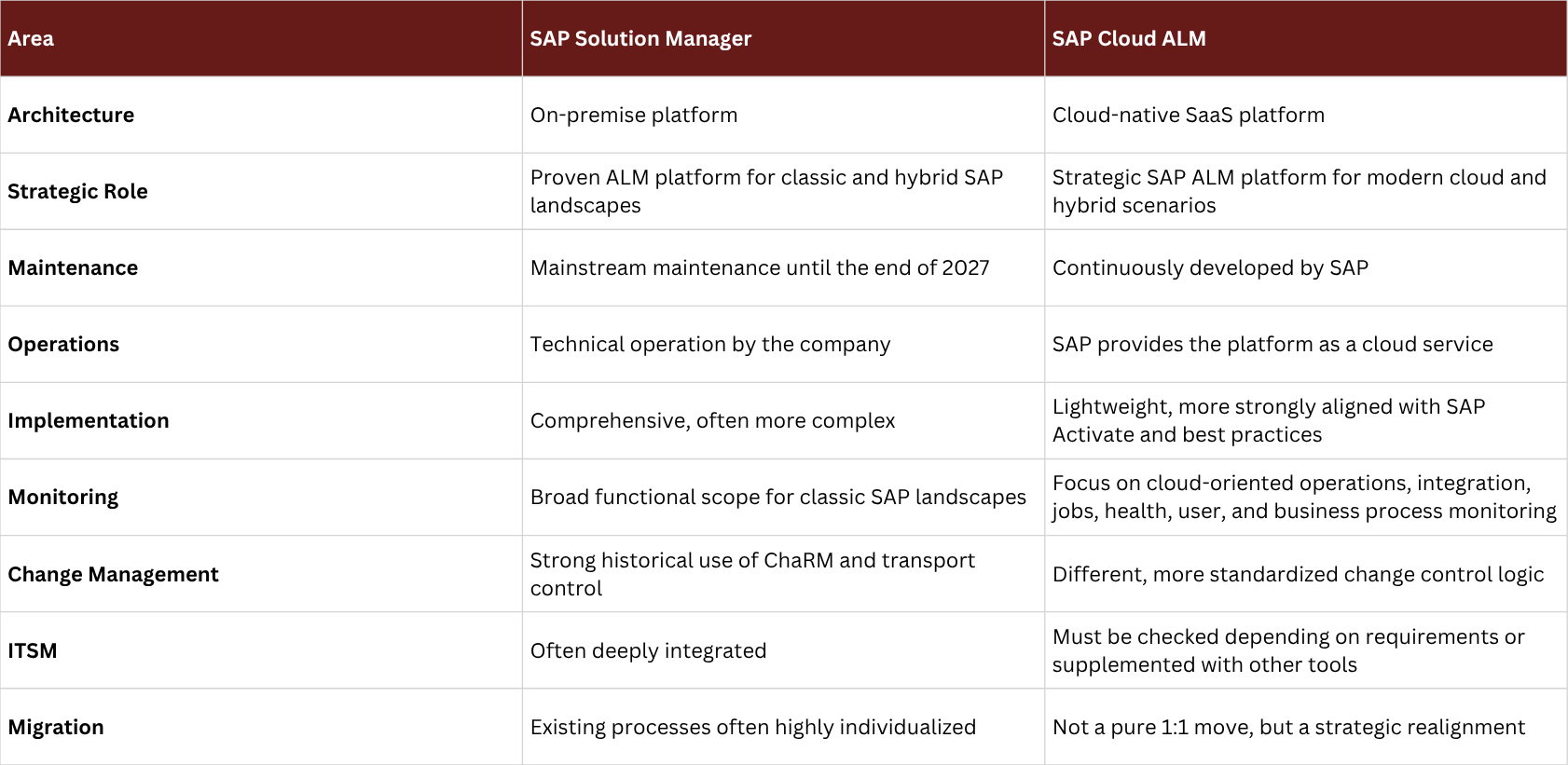
Many companies initially ask: "How do we migrate from Solution Manager to SAP Cloud ALM?"
The better question is: "Which ALM processes do we really need in the future?"
This is an important difference. SAP Cloud ALM forces companies to question existing structures. Not every historically grown process should be adopted. Not every old documentation is still relevant. Not every monitoring scenario delivers real added value.
The transition therefore offers an opportunity to make ALM leaner, more transparent, and more future-proof. At the same time, risks arise if companies start too late or view the transition purely technically.
Before switching to SAP Cloud ALM, companies should conduct a structured inventory. This is not just about functions, but about actual usage.
Important questions are:
Prioritization is particularly important. Not everything has to be changed at the same time. Companies should first identify the critical operational and governance processes and derive a realistic roadmap from them.
The end of 2027 is a clear deadline. SAP recommends completing the transition to SAP Cloud ALM before this time. For complex SAP landscapes, this is not a long lead time.
2026 is therefore the decisive year to create clarity. Companies should not wait until shortly before the end of maintenance to check how heavily they depend on Solution Manager. The earlier the inventory begins, the better risks, efforts, and alternatives can be evaluated.
It becomes particularly critical for companies that use Solution Manager intensively for ChaRM, ITSM, test management, monitoring, or process documentation. A simple tool change is not enough here. A clear ALM strategy is needed.
Lupus Consulting supports companies in evaluating and preparing the transition from SAP Solution Manager to SAP Cloud ALM in a structured manner. This includes analyzing existing Solution Manager usage, evaluating relevant SAP Cloud ALM functions, and developing a realistic transition roadmap.
This is not about transferring existing processes unchecked. The focus is on building ALM processes that are future-proof, efficient, and suitable for the company's SAP landscape.
Depending on the starting point, Lupus Consulting can support with the following topics:
SAP Cloud ALM does not simply replace SAP Solution Manager 1:1. It changes the ALM approach. Companies are moving from a comprehensive, often highly individualized on-premise platform to a cloud-native, more standardized, and future-oriented solution.
This can reduce complexity and better support modern SAP landscapes. At the same time, existing processes must be carefully checked, especially in the areas of monitoring, change management, test management, and ITSM.
Those who start the analysis in 2026 can plan the transition in a controlled manner. Those who wait until shortly before 2027 risk time pressure, functional gaps, and operational uncertainty.
For companies, now is therefore the right time to re-evaluate their own ALM strategy. Not only with the question of what SAP Cloud ALM can do, but with the question of which ALM processes they really need in the future.
Nearshoring your SAP Application Management Services offers compelling advantages over
Clean Core is one of the key principles of modern SAP landscapes. But many companies as