SAP
AMS
Atlassian
Products
Industries & Expertise
BEST-SHORING
Knowledge Base
SALESFORCE


SAP Bluefield migration, also known as Selective Data Transition, is a hybrid approach to S/4HANA transition that allows organizations to combine the "clean start" of a Greenfield implementation with the "data preservation" of a Brownfield conversion. By selectively migrating only the necessary master and transactional data into a fresh S/4HANA environment, businesses can achieve a clean core while retaining critical historical records, significantly reducing project risk and downtime.
When moving to SAP S/4HANA, companies traditionally faced a binary choice: start completely over (Greenfield) or convert their existing system as-is (Brownfield). Bluefield migration breaks this dichotomy. It involves setting up a new S/4HANA system and then using specialized software tools to "carve out" and migrate specific data sets—such as the last five years of financial history or active projects—from the legacy ECC system.
This approach is particularly valuable for large enterprises with complex global templates that need to consolidate multiple ERP instances or divest specific business units during the move to S/4HANA.
Choosing the right migration path is critical for project success. The following table highlights the key differences between the three primary strategies:
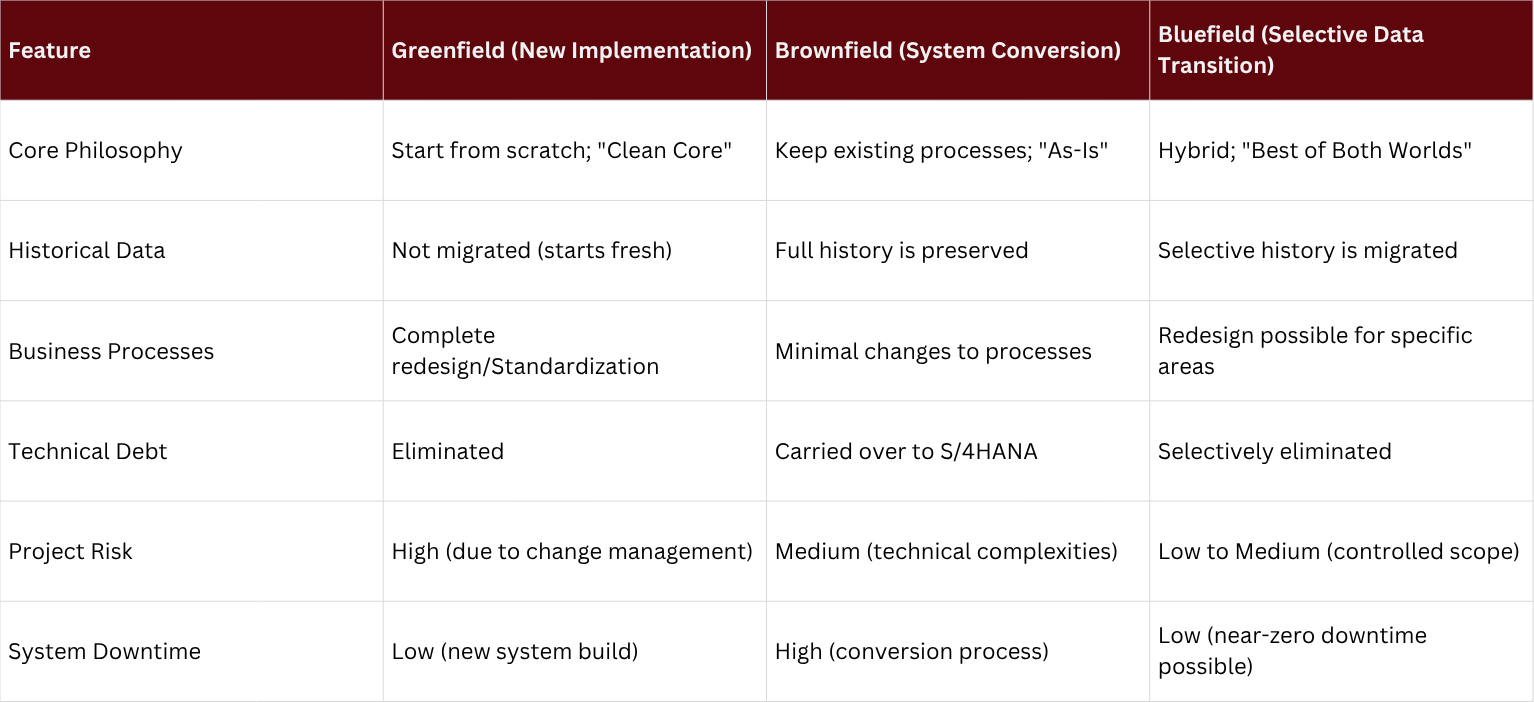
Unlike Greenfield, where you lose your historical data, Bluefield allows you to bring over exactly what you need. This is essential for compliance, auditing, and maintaining business continuity without bloating the new system with decades of obsolete data.
Bluefield enables you to leave behind years of custom code and technical debt. You can adopt SAP best practices and standard processes in the new S/4HANA system while still keeping the data that makes your business unique.
Because the new system is built in parallel, the final "go-live" involves a data migration rather than a full system conversion. This often results in significantly shorter downtime windows, which is a major advantage for 24/7 global operations.
If your organization is undergoing structural changes, Bluefield is the only approach that easily allows you to merge multiple legacy systems into one S/4HANA instance or split a single system into multiple entities during the migration.
The SAP Bluefield migration approach offers a strategic middle ground for organizations that cannot afford the total disruption of a Greenfield project but want to avoid the limitations of a Brownfield conversion. By focusing on Selective Data Transition, businesses can modernize their ERP landscape, achieve a clean core, and preserve their most valuable historical data—all while minimizing risk and downtime.


The ultimate phase-by-phase checklist for SAP custom code adaptation during S/4HANA mig