SAP
AMS
Atlassian
Products
Industries & Expertise
BEST-SHORING
Knowledge Base
SALESFORCE


Artificial Intelligence is only as good as the data that fuels it. For SAP users, achieving "AI Readiness" means moving beyond simple data collection to a strategy of data quality, governance, and architectural modernization. As SAP embeds generative AI (Joule) and predictive analytics across S/4HANA and BTP, organizations must ensure their data is clean, accessible, and structured to avoid the "garbage in, garbage out" trap. This guide provides a practical checklist to prepare your SAP landscape for the AI era.
Whether you are implementing SAP Joule for natural language queries or using AI for predictive maintenance, the underlying data must be reliable. AI models require high-quality, high-volume, and context-rich data to provide accurate insights. In an SAP environment, this often means overcoming decades of technical debt, custom code, and fragmented data silos.
Use this checklist to assess your current state and prioritize your data preparation efforts:
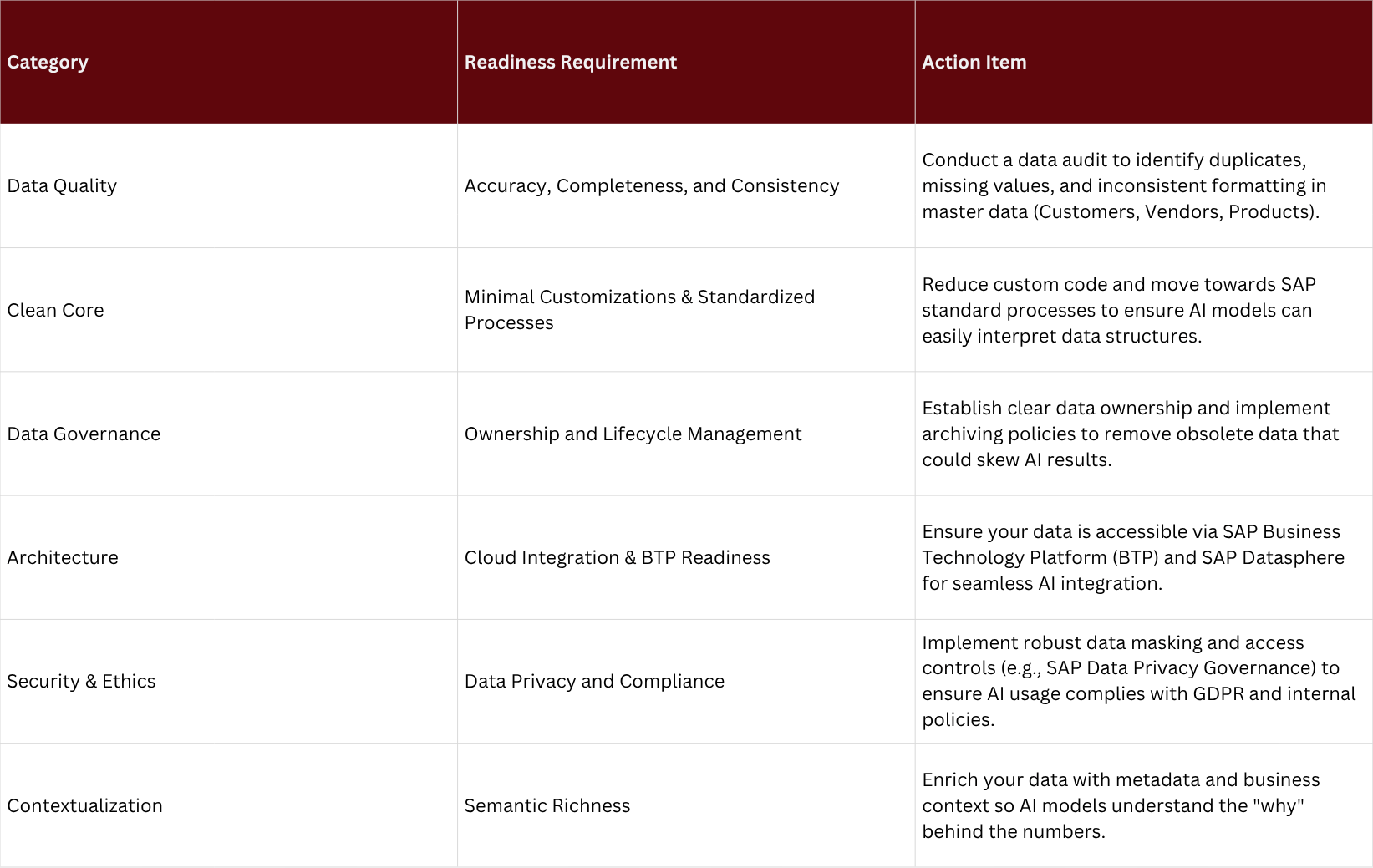
A "Clean Core" is no longer just about easier upgrades; it is a prerequisite for AI. By standardizing your SAP environment, you ensure that AI agents like Joule can navigate your business processes without getting lost in custom-built "spaghetti" code. Standard data structures allow for faster training and more reliable AI outputs. Expert partners like Lupus Consulting can help audit your legacy code and guide your S/4HANA migration to ensure it meets AI-ready standards.
To scale AI, you need a unified view of your data. SAP Datasphere (formerly Data Warehouse Cloud) allows you to integrate SAP data with non-SAP sources while preserving the business context (semantics). This "business data fabric" is essential for feeding AI models a comprehensive and accurate dataset.
AI thrives on consistency. If "Customer A" is recorded differently across three different SAP modules, your AI will treat them as three different entities. Harmonizing master data across the enterprise is the single most impactful step you can take toward AI readiness.
Preparing your SAP data for AI is not a one-time project but a continuous journey of improvement. By following this readiness checklist and focusing on a clean core and robust data governance, you can transform your SAP data from a legacy burden into a strategic AI asset. The goal is to create a foundation where AI doesn't just work—it excels.