SAP
AMS
Atlassian
Products
Industries & Expertise
BEST-SHORING
SALESFORCE


In today’s fast-paced digital landscape, IT Service Management (ITSM) is no longer just about fixing broken laptops and resetting passwords. It has evolved into a strategic enabler of business agility, employee productivity, and cross-departmental collaboration. However, many organizations find themselves constrained by legacy ITSM tools that are rigid, expensive, and disconnected from the development workflows where value is created. This is where Jira Service Management (JSM) is changing the game.
Jira Service Management, Atlassian’s purpose-built ITSM solution, offers a modern, agile, and scalable alternative that empowers over 45,000 companies to deliver exceptional service experiences. With a reported 277% return on investment and the ability to recover 115 hours per month for IT teams, JSM is not just another ticketing system—it is a platform for enterprise-wide service delivery.
This guide provides a comprehensive framework for building a scalable ITSM solution with Jira Service Management, from initial setup to enterprise-wide expansion. We will cover best practices, automation strategies, and a step-by-step roadmap to transform your service delivery from a cost center into a strategic asset.
Before diving into the implementation roadmap, it is crucial to understand why JSM is inherently designed for scalability. Unlike traditional ITSM tools that were built for a pre-agile world, JSM is built on the same platform as Jira Software, the world’s leading tool for agile development teams. This native integration provides a unique advantage.
Building a scalable ITSM solution is a journey, not a one-time project. This six-step framework provides a structured approach to implementing and scaling Jira Service Management across your organization.
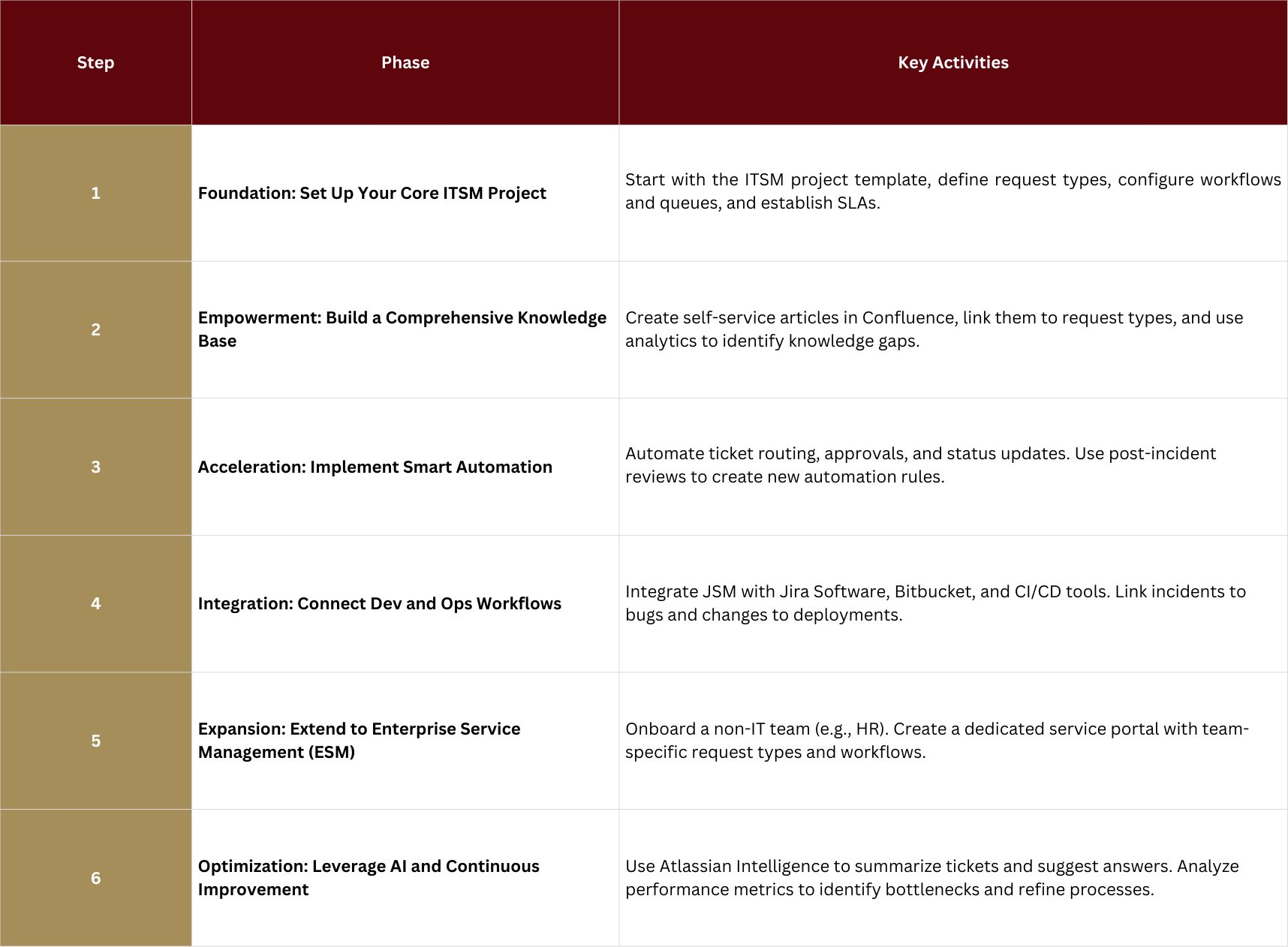
The first step is to establish a solid foundation for your IT support operations. Jira Service Management makes this easy with its pre-configured ITSM project template, which is PinkVERIFY™ certified for core ITIL processes.
A scalable ITSM solution deflects common requests by empowering users to find answers themselves. JSM’s seamless integration with Confluence is a key enabler of self-service.
Automation is the engine of scalability. By automating repetitive tasks, you free up your team to handle more complex issues and strategic work. JSM’s automation engine is both powerful and easy to use.
True scalability comes from breaking down silos. JSM’s native integration with the Atlassian development suite allows you to create a seamless flow of work from customer support to code deployment.
Once you have optimized your IT service delivery, the next step in scaling is to extend these capabilities to other business departments. This is known as Enterprise Service Management (ESM), and it is where JSM truly shines.
Scalability is not a static state; it requires continuous optimization. Atlassian Intelligence, JSM’s built-in AI capability, provides powerful tools for ongoing improvement.
Building a scalable ITSM solution is about more than just implementing a new tool. It is about adopting a new mindset—one that prioritizes agility, collaboration, and continuous improvement. By following this six-step framework, organizations can leverage Jira Service Management to transform their service delivery from a reactive cost center into a proactive, strategic business partner.
Start by building a solid foundation for your IT operations, then empower users with self-service, accelerate processes with automation, and break down silos between Dev and Ops. From there, you can expand your success across the enterprise, bringing the benefits of modern service management to every department. With Jira Service Management, scalability is not just a feature—it is the foundation of your entire service delivery strategy.

From marketing to HR and operations—discover how Trello helps non-technical teams stay

Smarter Search, Better Dashboards: Unlock the full power of Jira with Smart Filters and