SAP
AMS
Atlassian
Products
Industries & Expertise
BEST-SHORING
SALESFORCE


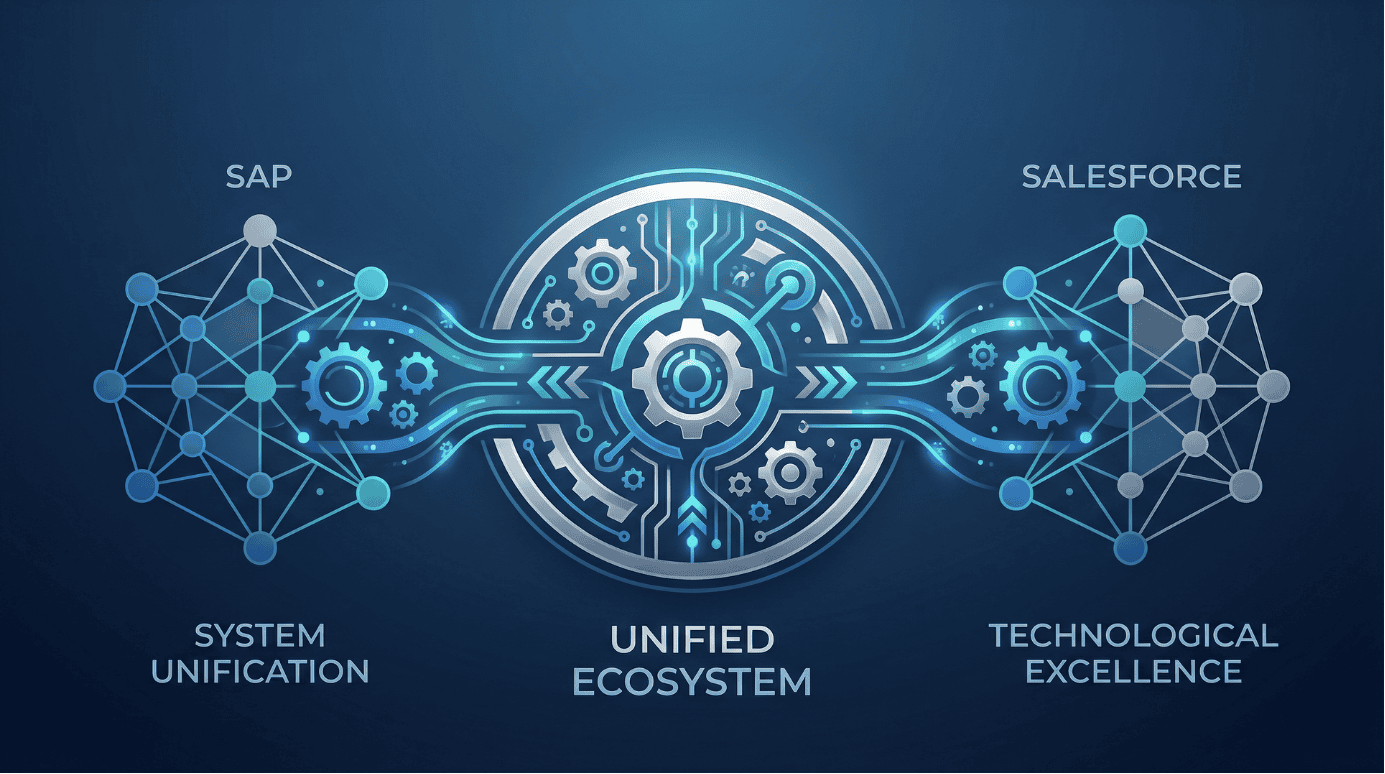
Our client was running on two of the most powerful enterprise platforms in the world: SAP for their ERP and Salesforce for their CRM. But with two different vendors managing them independently, they were living with a ticking clock. The challenges were mounting in ways both visible and invisible.
Slow and unpredictable response times from their previous Salesforce partner meant that when critical issues arose, teams were left waiting in the dark. For a sales organization, every hour of downtime is a lost opportunity. Inconsistent quality of fixes across different business units created a frustrating patchwork of solutions. But the deepest problem was something more fundamental: a lack of integration knowledge between SAP and Salesforce. With separate vendors managing them independently, there was no unified vision. Data inconsistencies became routine. Reporting was unreliable.
Unpredictable support from previous vendor left teams waiting in the dark
Fixes varied across different business units, creating frustrating patchwork solutions
Lack of SAP-Salesforce knowledge led to data inconsistencies and unreliable reporting
Sales delays, poor customer service, and frustrated internal teams
"Partnering with Lupus for Salesforce, on top of our SAP AMS collaboration, finally gave us a single, accountable partner for our core platforms. The improvement in stability and responsiveness was visible within the first months."
— Business Application Manager (IT Vice President)
After three years of successful SAP Application Management Services, Lupus Consulting had already earned the client's trust. We understood their business, their systems, and their goals. When critical issues arose with SAP, we fixed them quickly and thoroughly. When the client needed to migrate from SAP ECC to S/4HANA, we managed a complex transition that kept the business running smoothly.
So when Lupus Consulting proposed taking over Salesforce AMS services and becoming the primary delivery partner for all Salesforce projects, it wasn't a leap of faith—it was a natural evolution of a partnership that had already proven its value.
What made the proposal compelling was the specific approach: a unified SAP + Salesforce AMS and project delivery model that would reduce complexity and eliminate vendor fragmentation. We proposed a dedicated, senior Salesforce team with proven expertise in B2B, e-Commerce, Service Cloud, Sales Cloud, Marketing Cloud, Experience Cloud, Einstein/AI, and MuleSoft integration. We outlined a standardized AMS framework that would apply common incident, problem, and change management processes across both platforms, creating consistency and predictability.
By consolidating their SAP and Salesforce AMS and project delivery with Lupus Consulting, the client didn't just get a new vendor. They got a new way of working.
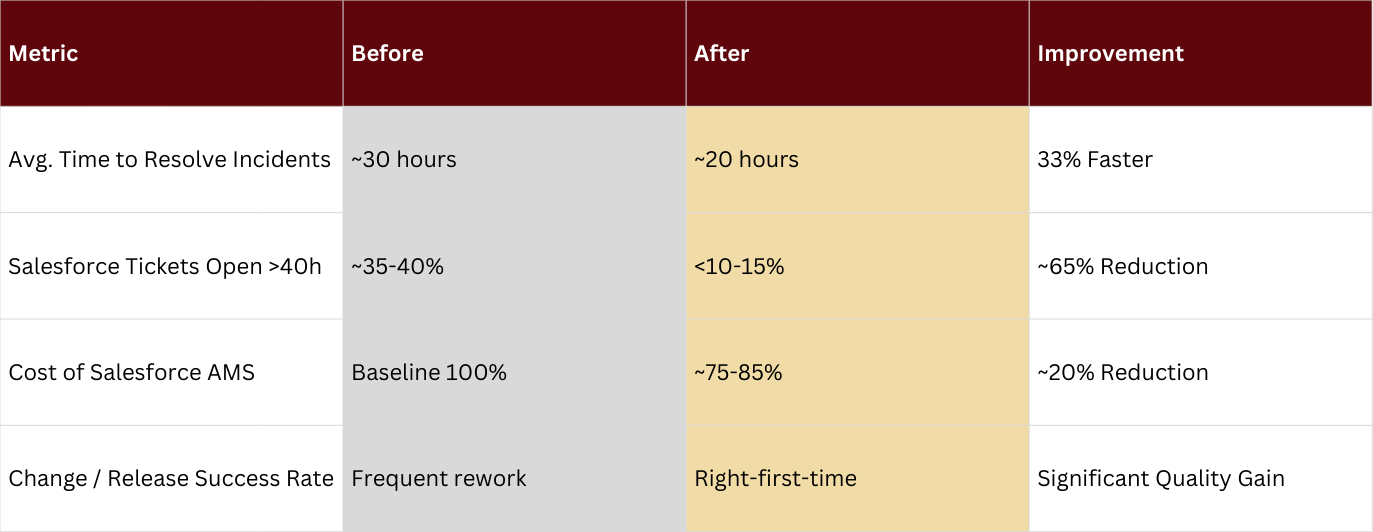
Faster Incident Resolution
Reduction in Aged Tickets
Cost Reduction
Senior Professionals on AMS
After three years of successful SAP AMS, Lupus Consulting had earned the client’s trust. We knew their business, stabilized critical SAP issues, and delivered a smooth SAP ECC to S/4HANA migration. So when we proposed taking over Salesforce AMS and becoming the primary delivery partner, it was not a leap of faith it was the natural next step in a proven partnership.
We ran joint handover sessions, documented all processes and configurations, and aligned governance with the existing SAP AMS setup. The transition was phased: we started with the most critical Salesforce areas, proved stability, and then expanded step by step, ensuring zero disruption to the business.
When documentation from the previous provider proved incomplete, we rebuilt the missing knowledge through reverse engineering, system trace analysis, and focused workshops with key users. This combination of technical insight and business collaboration resulted in a solid knowledge base, enabling proactive management and continuous improvement.
Business and IT stakeholders now view Salesforce as a reliable, well-managed platform they can depend on.
The integrated SAP-Salesforce view enables faster, data-driven decisions based on accurate reporting.
When systems work reliably and issues are resolved quickly, the people using them are happier and more productive.
Today, the client has more than just a stable and efficient IT landscape. They have a strategic partner who is proactively identifying opportunities for innovation and growth. With a unified view of their entire enterprise ecosystem, they are better equipped to make faster, data-driven decisions and stay ahead of the competition.
If your organization is facing similar challenges, like managing multiple vendors, struggling with system integration, or missing opportunities because your platforms aren't working together—this story is for you. It's proof that there's a better way.