SAP
AMS
Atlassian
Products
Industries & Expertise
BEST-SHORING
SALESFORCE


As a leading global consumer goods company specializing in essential health and hygiene products like incontinence care, feminine hygiene, and tissue products, our customer operates a vast technological infrastructure with thousands of users. Staying at the forefront of digital transformation and ensuring systems remain operational during migrations without extended downtimes is not just a necessity—it’s an absolute requirement.
bn EUR Revenue
Employees
Industry
The Challenge
Breaking Free from Legacy: A Complex Path to Implementing SAP S/4HANA using the greenfield approach.
The project faced a series of challenges due to the high demand from various business areas, including SD, FI, and Warehouse, each pushing requirements onto the development teams. This influx of requests added to an already substantial backlog, compounded by both internal and external workload pressures.
The legacy ECC system, more than 20 years old and filled with custom codes, was a major hurdle. The primary goal of the digitization project was to implement all core processes into the new SAP S/4HANA system, with a strong focus on performance and introducing S/4HANA-specific rules, development guidelines, and best practices.
Adding complexity, a large international consulting firm was leading the digitization effort, while Lupus Consulting gradually assumed responsibility for development tasks across various streams, including SAP S/4HANA, EWM, APO, and ECC.
With sprint capacities already overbooked due to the growing backlog, user story details from the leading partner were only delivered at the beginning of each sprint, further constraining delivery timelines and making it harder to meet project milestones.
The Solution
Redesigning processes, refactoring code to align with S/4HANA standards, and adopting a Scrum-based methodology to manage development tasks and ensure continuous progress.
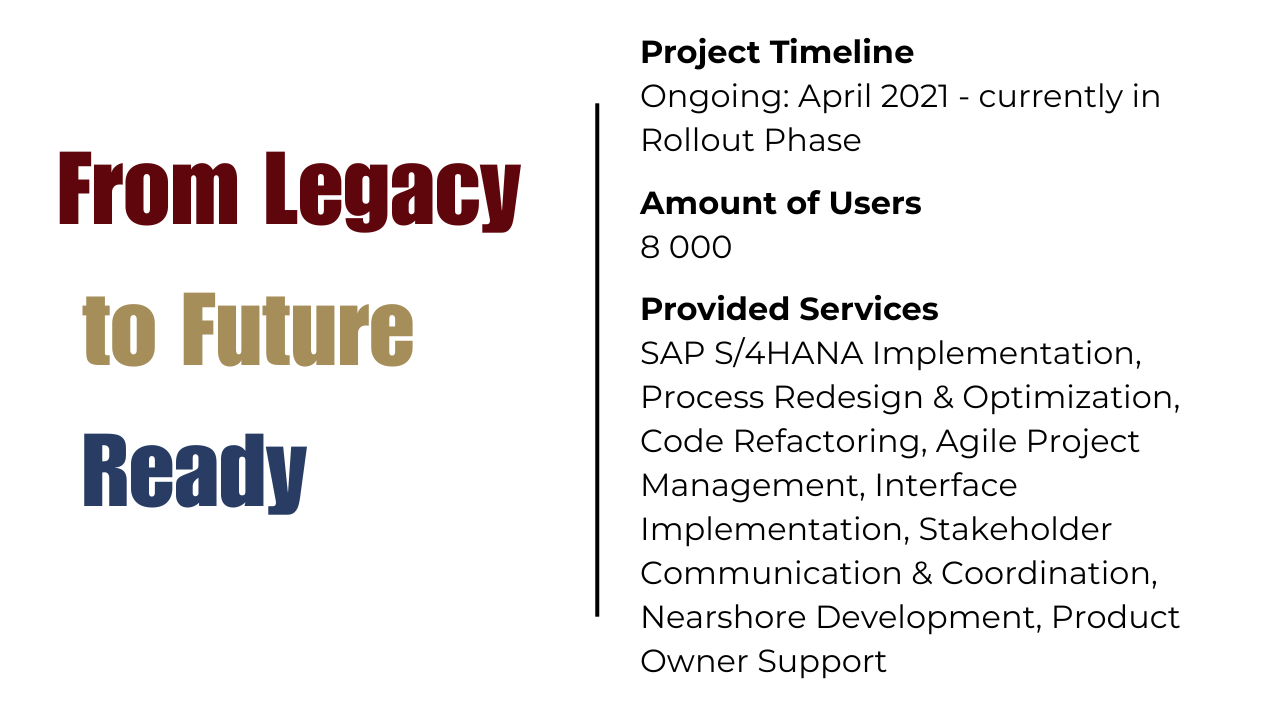
To ensure business continuity during the transition, we implemented a robust interface between the new SAP S/4HANA system and the legacy SAP ECC platform. This allowed for seamless integration and smooth business operations while we redefined and built new processes within SAP S/4HANA, alongside adapting existing ECC processes.
We also focused on re-factoring the previously implemented code, aligning it with SAP S/4HANA-specific rules and developer guidelines, ensuring a more efficient and standardized development approach.
Adopting a Scrum-based methodology was key to managing the complexities of the project. We established a clear backlog for all user stories and held daily Scrum meetings with the development team to ensure steady progress and timely delivery.
Lupus Consulting's Senior Developer took on the critical role of coordinating user stories and task assignments, keeping the team aligned and driving optimal results across all streams.
The Result
Coordinating technical requirements, managing communication across all levels, and leveraging a flexible nearshore team of specialists to scale development efforts as needed.
The project is currently in the rollout phase, with ongoing progress.
Lupus Consulting's Product Owner (PO) maintains close communication with the customer’s stakeholders to align on technical requirements and ensure seamless coordination.
The Lupus PO is responsible for managing all levels of communication across management, business, and delivery teams, ensuring transparency and alignment throughout the process.
Backlog prioritization is done collaboratively within the team, ensuring that the most critical tasks are addressed first.
Serving as the Single Point of Contact for the backlog’s progress, Lupus ensures smooth and efficient execution.
A nearshore approach, utilizing a team of highly skilled specialists, provides the flexibility and scalability needed for the project, with the ability to rapidly scale the development team from 15 to 70 developers as needed.