SAP
AMS
Atlassian
Products
Industries & Expertise
BEST-SHORING
SALESFORCE


Musashi is a global automotive supplier with operations spanning eight countries and 16,000 employees worldwide. In Europe alone, the company operates across Germany, Spain, and Hungary with approximately 2,500 employees and €550 million in annual revenue. Yet despite this scale, Musashi Europe faced a critical challenge: fragmentation.
While every other region had already migrated to the global SAP S/4HANA platform, Europe remained isolated across multiple separate ECC systems. Six German company codes operated in isolated ECC environments. Two Hungarian entities ran on a separate ECC system and legacy non-SAP platforms. This fragmentation created a cascade of operational inefficiencies, higher support costs, and lost synergies.
Six German company codes operating in isolated ECC systems, disconnected from global S/4HANA platform
Finance and purchasing teams working in parallel across multiple systems with reconciliation challenges
Multiple systems requiring specialized expertise and higher maintenance overhead
Unable to leverage global best practices and unified reporting available in other regions
The migration of six German company codes to SAP S/4HANA represents a significant technical achievement. But the real value extended beyond these technical metrics.
Company Codes Migrated
Production Plants Live
On-Time Delivery
Z* Programs
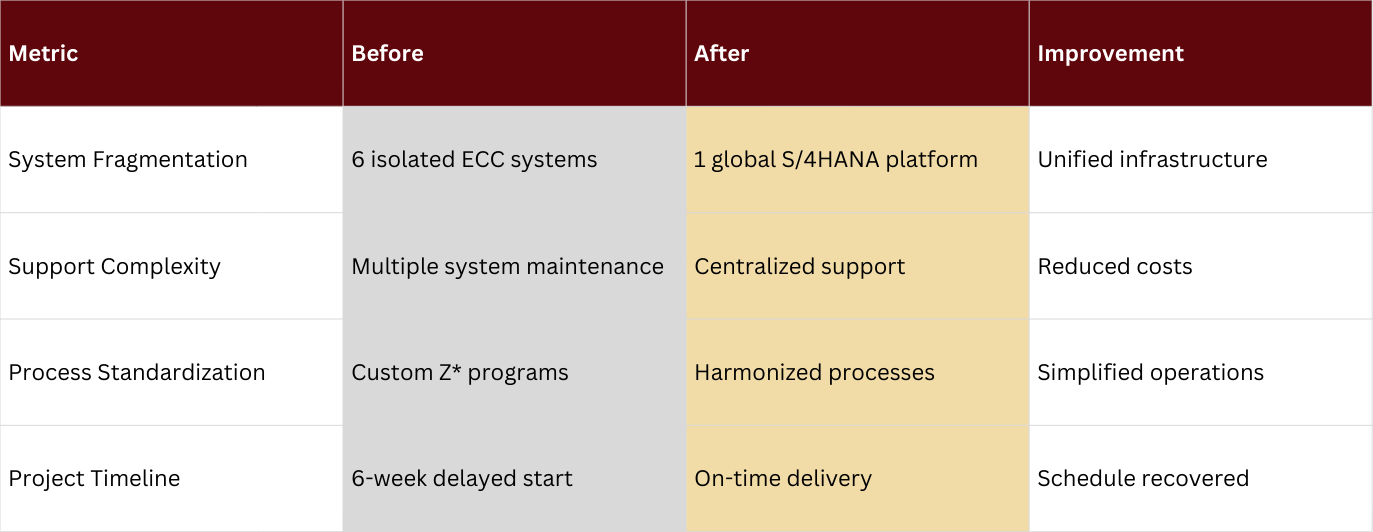
Over five months, we conducted intensive workshops with business stakeholders and reverse-engineered existing processes. The team identified critical gaps between the current state and global S/4HANA standard, revealing significant opportunities for process simplification and Z* program reduction.
Rather than attempting simultaneous migration, we developed a phased approach split into three waves. Wave 1 focused on six German company codes with two staggered go-lives (December 2025, February 2026), reducing risk and allowing for learning between phases.
When a six-week delay threatened the timeline, we shifted to aggressive agile methodology with overlapping implementation and testing phases. Despite numerous change requests and unplanned Z* programs, we maintained both go-live dates and delivered under budget.
Financial (FICO), purchasing, sales, and all printouts harmonized with global standards. Significant reduction in custom Z* programs reduces technical debt and maintenance complexity.
Consolidation of six separate ECC systems into one global platform immediately reduces IT infrastructure complexity, support costs, and maintenance overhead.
Wave 1 success validates the approach and creates a template for Wave 2 (Hungary) and Wave 3 (Spain + Germany), positioning Musashi for continued expansion.

