SAP
AMS
Atlassian
Products
Industries & Expertise
BEST-SHORING
SALESFORCE


In the era of cloud transformation, a critical question for any organization running SAP is how to architect its extension and innovation strategy. The choice often boils down to two powerful options: leveraging the SAP Business Technology Platform (BTP), SAP’s own Platform-as-a-Service (PaaS) offering, or building on one of the major hyperscalers like Amazon Web Services (AWS), Microsoft Azure, or Google Cloud Platform (GCP). A common misconception is that these are competing choices, forcing a binary decision. The reality is far more nuanced and powerful.
The most effective strategy is not about choosing one over the other, but understanding when to use which—and how to make them work together. This article provides a decision framework for architects, developers, and IT leaders to navigate this choice, ensuring that every SAP extension delivers maximum value, whether it is built on SAP BTP, a hyperscaler, or a combination of both.
To make an informed decision, it is essential to understand the fundamental difference in their design philosophies. SAP BTP is not a hyperscaler competitor; it is a complementary platform designed to be the best place to extend and integrate with SAP applications.
SAP itself acknowledges this synergy. SAP BTP is often hosted on hyperscaler infrastructure, allowing customers to run their SAP PaaS layer on the same IaaS provider they use for other workloads, creating a powerful combination of SAP-specific services and general-purpose cloud capabilities.
SAP BTP shines brightest when the extension is deeply intertwined with SAP processes, data, or user experience. It provides a “low-code/no-code” to “pro-code” environment that accelerates development by abstracting away the complexities of SAP integration.
Choose SAP BTP for:
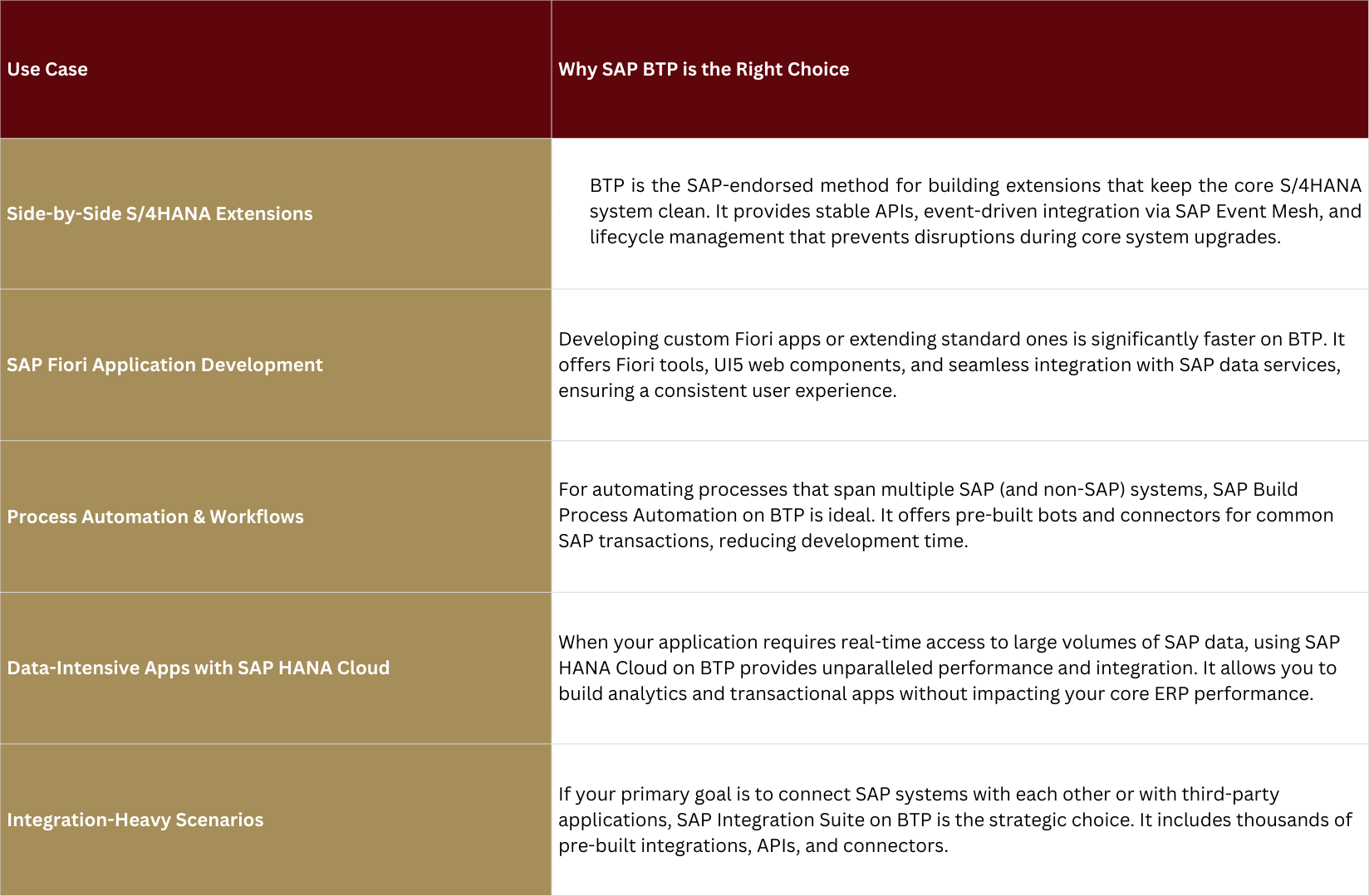
In essence, if the question involves “How do I extend my SAP process?” or “How do I get access to my SAP data securely?”, the answer almost always starts with SAP BTP.
Hyperscalers are the platform of choice when the application is not SAP-centric or requires specialized capabilities that go beyond BTP’s current offerings. Their sheer scale and pace of innovation make them ideal for a wide range of use cases.
Choose a Hyperscaler for:
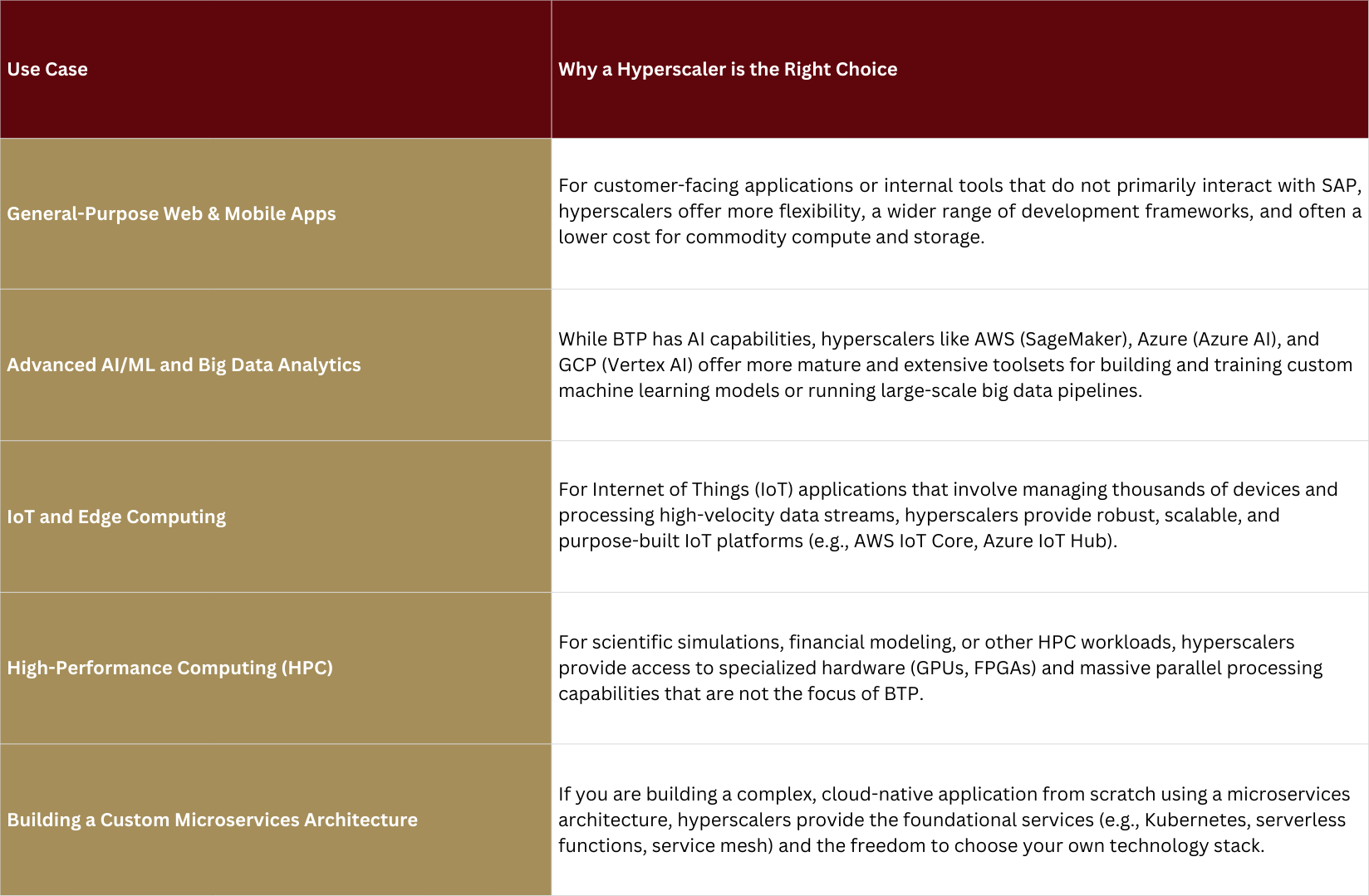
If the question is “How do I build a scalable, custom application?” and SAP is just one of many data sources, a hyperscaler is likely the better starting point.
The most powerful and common architectural pattern is not an “either/or” choice but a “both/and” strategy. In this hybrid model, organizations use SAP BTP as the integration and extension layer for the SAP core, while leveraging hyperscaler services for everything else. This creates a clean, secure, and scalable architecture.
Consider a common scenario: a manufacturing company wants to build a predictive maintenance application for its factory equipment. The application needs to:
Hyperscaler (e.g., AWS):
SAP BTP:
This architecture leverages the strengths of both platforms: the hyperscaler for its best-in-class IoT and AI capabilities, and SAP BTP for its secure, reliable, and simple integration with the SAP core. Attempting to build the SAP integration directly from the hyperscaler would require complex networking, custom authentication code, and deep knowledge of SAP APIs, all of which BTP provides out of the box.
Viewing SAP BTP and hyperscalers as competitors leads to flawed architectural decisions. The correct approach is to see them as partners in a modern enterprise cloud strategy. SAP BTP is the bridge that connects your stable, mission-critical SAP core to the fast-moving, innovative world of hyperscaler services.
To build a future-proof SAP extension strategy, follow this simple rule of thumb:
By understanding the unique strengths of each platform and designing a strategy that leverages both, organizations can unlock the full potential of the cloud, driving innovation while ensuring their core business processes remain stable, secure, and efficient.